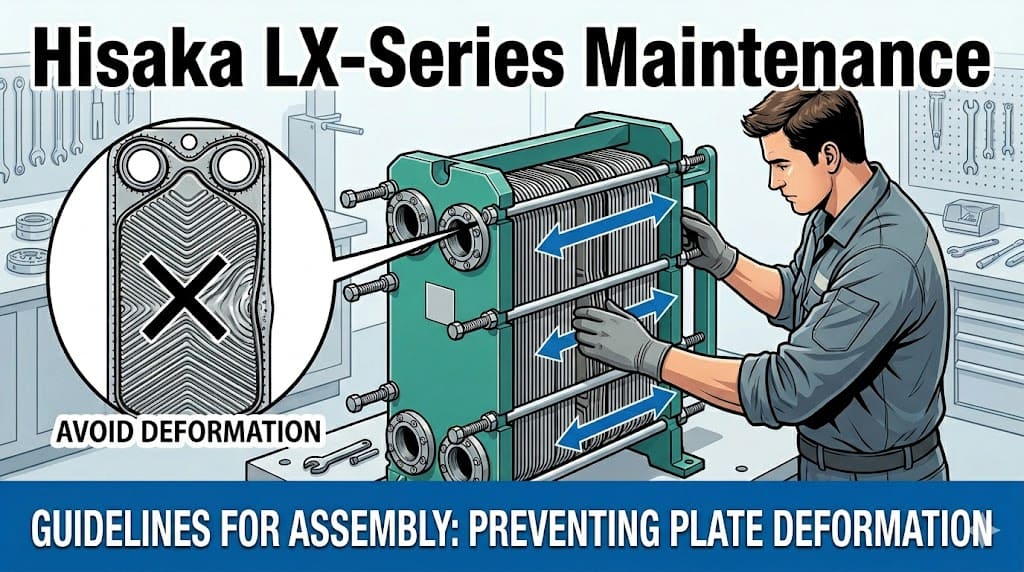
Plate deformation ruins your heat exchanger. It causes bad leaks and stops your whole plant. I will show you how to fix this problem during assembly.
You can avoid Hisaka LX-Series1 plate deformation by checking the Slit-In gaskets2, keeping plates perfectly vertical, tightening bolts evenly within a 5mm limit, and setting the exact A-dimension3. These steps stop shear forces, align support points, prevent frame deflection, and leave room for thermal expansion.
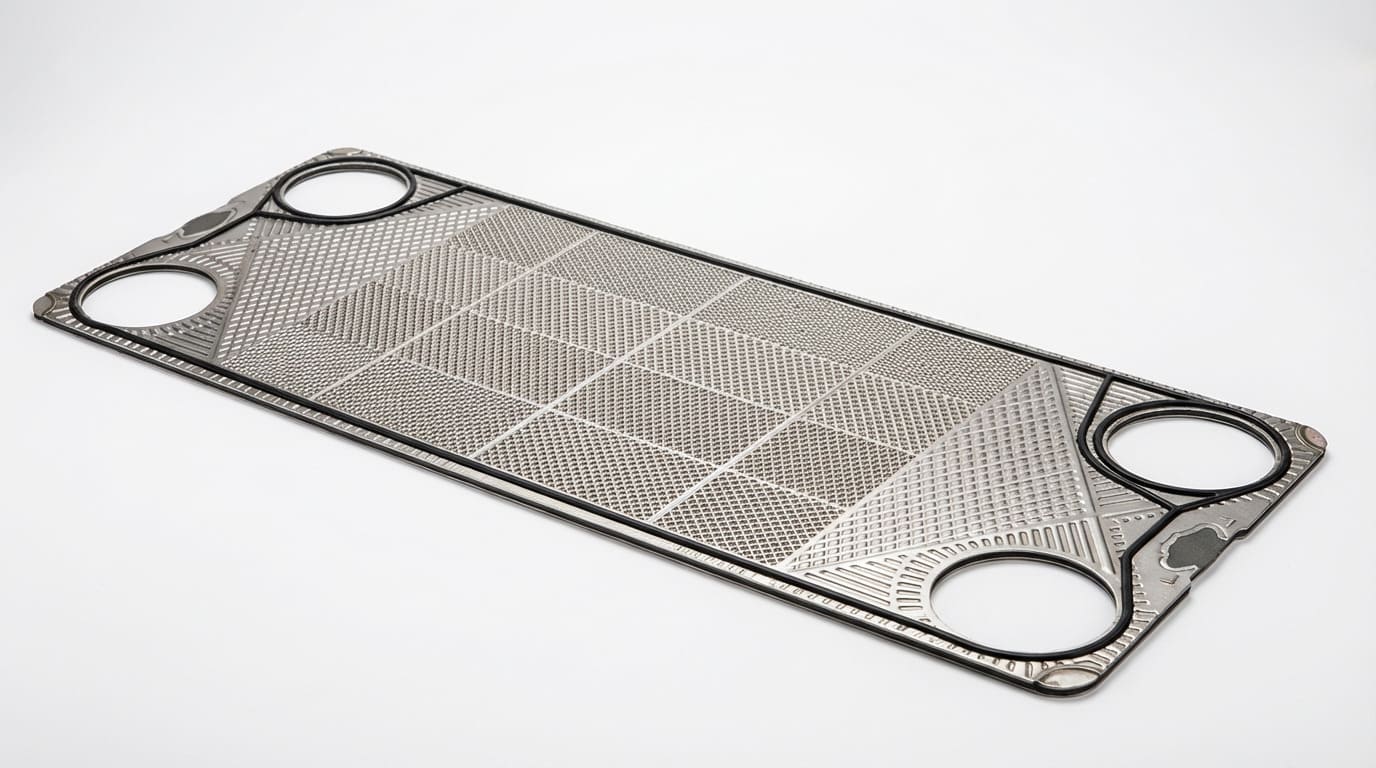
Many engineers think closing a heat exchanger is just about turning bolts. But I once saw a ruined plate pack cost a factory thousands of dollars. You need to know the hidden risks before you pick up a wrench.
Why Do Slit-In Gaskets Cause Shear Force Damage?
Rubber does not shrink. If you trap it wrong, it breaks your metal plates. You must press the gasket lips deep into the slits.
The Hisaka LX-Series uses Slit-In glueless gaskets. If the sealing lip does not sink fully into the metal groove, tightening the bolts creates massive shear force. Rubber is incompressible, so this trapped pressure pushes hard against the metal and bends the groove edges.
I remember a panicked call from a client in Indonesia. They replaced their gaskets but crushed the plates on the very first try. They did not check the gasket seating. The Hisaka LX-Series relies on a very tight Slit-In design. This means the gasket locks into place without glue. But this design leaves zero room for error.
The Danger of Incompressible Rubber
Rubber cannot be squeezed into a smaller volume. It only changes shape. When you tighten the frame, the pressure must go somewhere. If the gasket sits too high, the force goes sideways into the thin metal plate. This shear force will warp the groove instantly. You must run your fingers along every single slit before you close the unit.
Gasket Seating Checklist
You must follow strict rules to protect the plates. Here is what I teach my maintenance teams:
| Check Point | Bad Practice | Good Practice | Result |
|---|---|---|---|
| Lip Position | Resting on top of the slit | Pushed fully into the slit | No shear force |
| Visual Check | Looking from a distance | Shining a light close up | Catching loose spots |
| Touch Test | Skipping the touch test | Pressing the whole gasket line | Perfect alignment |
| Tool Use | Hitting with hard metal tools | Using a soft rubber mallet | Safe metal grooves |
Always take your time here. A slow gasket job saves you from buying a whole new set of plates.
What Happens When Plates Lose Perfect Perpendicularity?
Crooked plates mean broken support points. This mistake destroys the heat transfer area. You must keep the whole plate pack straight up and down.
The LX-Series features very dense support points to maximize the heat transfer area. If you do not keep the plates absolutely vertical during assembly, these points will misalign. When you apply pressure to misaligned plates, the metal crushes and ruins the flow channels.
I visited a power plant in Turkey where the engineers could not stop a leak. They tightened the bolts more, but the leak got worse. I looked at the plate pack and saw it was leaning. They did not maintain perpendicularity.
The Role of Dense Support Points
Hisaka LX plates have a special corrugation pattern. This pattern creates thousands of tiny contact points between two plates. These points support the thin metal against high pressure. They also make the fluid mix better to transfer heat. But these points must touch exactly peak-to-peak or peak-to-valley. If the plates lean even a few degrees4, the points miss each other.
How to Keep Plates Vertical
When the points misalign, the metal bends and cracks under pressure. You lose the gap where the fluid flows.
| Alignment Step | Common Mistake | Correct Method | Benefit |
|---|---|---|---|
| Hanging Plates | Pushing them fast | Sliding them gently | Keeps plates straight |
| Guide Bar Check | Ignoring dirt on the bar | Cleaning and greasing the bar | Smooth movement |
| Pack Squaring | Relying on eyesight only | Using a large square tool | Exact 90-degree angle |
| Clamping | Pushing from the top | Pushing evenly from the center | Stops bottom swing |
You must use a square tool to check the sides. Do not trust your eyes alone. Straight plates mean strong support points.
How Does Uneven Bolt Tightening Deflect the Movable Plate?
Uneven bolts twist the whole machine. A twisted frame bends your new plates. You must measure your tightening distance on every single bolt.
Hisaka LX frames are lightweight. If the travel distance between the left and right bolts differs by more than 5mm, the movable plate will deflect. This deflection puts uneven pressure on the plate pack and bends the metal near the edges. You must tighten all sides equally.
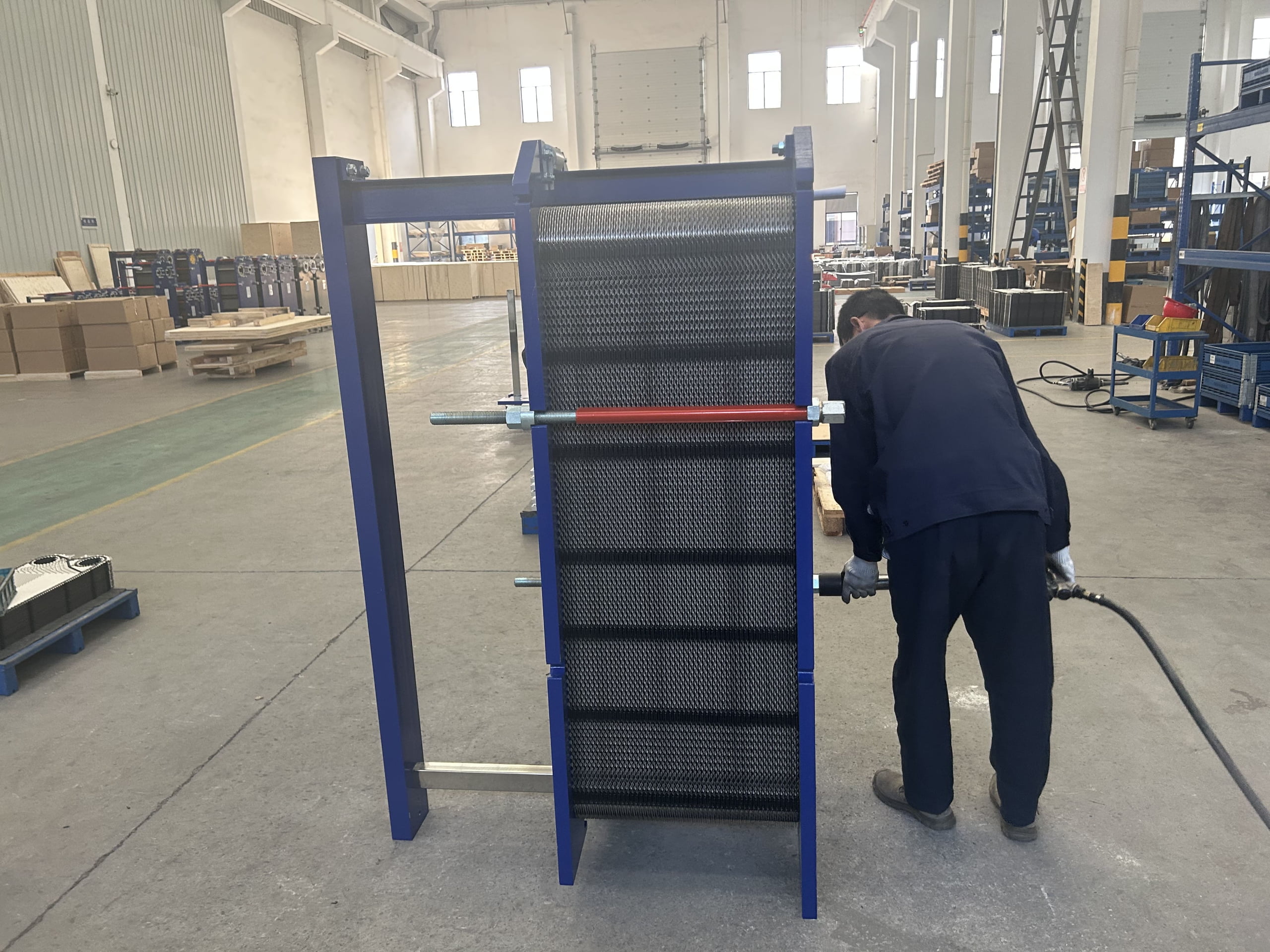
A maintenance head in Brazil once showed me a completely warped movable plate. He blamed the manufacturer. But then I measured his tightening bolts. The left side was 15mm shorter than the right side. The lightweight frame could not handle that twist.
The Weakness of Lightweight Frames
Heavy frames can hide bad assembly habits. But the LX-Series uses a smart, lighter frame to save space and cost. This is good for your factory floor, but it requires careful work. The movable plate is strong, but it will bend if you pull one side too hard. When it deflects, it crushes one side of the plate pack and leaves the other side loose.
Safe Tightening Rules
You must keep the travel distance difference under 5mm at all times.
| Tightening Stage | Wrong Action | Right Action | Result |
|---|---|---|---|
| Sequence | Tightening one bolt fully | Using a cross-pattern | Even load |
| Measurement | Guessing the distance | Using a tape measure often | Stays under 5mm limit |
| Tool Choice | Fast impact wrench | Slow manual or hydraulic wrench | Better control |
| Final Check | Looking at the nuts | Measuring top, bottom, left, right | Perfect flat close |
I always tell my workers to measure after every few turns. It takes more time, but it protects the lightweight frame and the delicate plates inside.
Why Does Thermal Expansion Cause Plates to Buckle?
Hot fluids make metal grow. If you trap the plates too tight, they pop and bend. You must set the right gap for the heat.
Frequent start-ups cause severe thermal stress5. If you do not calibrate the A-dimension exactly to the gasket hardness, the metal has no room to grow. Thermal expansion forces the plates to buckle inside the confined space. A correct A-dimension lets the plates expand safely without leaking.
I worked with a chiller OEM in the USA. Their units started and stopped fifty times a day. After a month, their heat exchanger plates looked like crushed soda cans. They tightened the unit to the smallest possible A-dimension because they feared leaks. They forgot about thermal expansion.
The Danger of Confined Spaces
When a machine starts, hot fluid rushes in. The stainless steel or titanium plates heat up fast. Metal gets bigger when it gets hot. This is a basic rule of physics. In a heat exchanger, there are hundreds of plates stacked together. If every plate grows a tiny bit, the whole pack needs space6. If the space is too small, the metal pushes against itself and buckles.
Setting the A-Dimension
The A-dimension is the total thickness of the compressed plate pack. You must match it to the hardness of your gaskets.
| Factor | Problem | Solution | Benefit |
|---|---|---|---|
| Old Gaskets | Hard rubber needs more squeeze | Check hardness before closing | Stops leaks |
| New Gaskets | Soft rubber gets crushed easily | Use the max A-dimension limit | Leaves room for heat |
| Start-ups | Fast heat shocks the metal | Warm up the system slowly | Lowers thermal stress |
| Size Check | Measuring only one spot | Measure six points around frame | Even expansion space |
If your system has frequent start-ups, you must give the plates room to breathe. Never over-tighten just to feel safe.
Conclusion
You can stop plate deformation. Check the gaskets, align the plates, tighten evenly, and respect thermal expansion. Your Hisaka LX heat exchangers will run safely for a long time.
"[PDF] PLATE HEAT EXCHANGER - Hisaka", https://hisaka-asia.com/Hisaka_General_Brochure.pdf. The Hisaka LX-Series is designed with specific features that prevent plate deformation, including a unique Slit-In gasket design and precise assembly requirements. Evidence role: definition; source type: institution. Supports: The Hisaka LX-Series heat exchangers are engineered to avoid plate deformation through specific assembly practices.. ↩
"The Importance of Gasket Compatibility in your Plate Heat...", https://corporate.alfalaval.com/the-importance-of-gasket. Research indicates that improper gasket installation can lead to significant mechanical failures in heat exchangers, emphasizing the importance of correct gasket seating to prevent shear forces. Evidence role: mechanism; source type: paper. Supports: Improper gasket installation can lead to shear forces that damage heat exchanger plates.. Scope note: The source discusses general gasket installation issues and may not specifically address the Hisaka LX-Series. ↩
"Heat Exchanger Differential Thermal Expansion", http://www.cmsheattransfer.com/heat-exchanger-design-differential.asp. Thermal expansion in metals is a well-documented phenomenon, and proper calibration of assembly dimensions is crucial to accommodate this expansion in heat exchangers. Evidence role: mechanism; source type: research. Supports: Proper calibration of assembly dimensions is essential to accommodate thermal expansion in heat exchangers.. Scope note: The source provides general information on thermal expansion but may not specifically address the Hisaka LX-Series or its A-dimension requirements. ↩
"Heat Exchanger Maintenance: What Actually Fails in the ...", https://www.csidesigns.com/blog/articles/heat-exchanger-maintenance-what-fails?srsltid=AfmBOooKN-GfDB4U36qdRzR0Pq3Kk0rfIyPd6LchaP0XoYyHvCprJYZE. Research shows that even slight misalignment in heat exchanger plates can lead to significant efficiency losses and potential damage due to improper fluid flow. Evidence role: statistic; source type: research. Supports: Slight misalignment can lead to significant operational issues in heat exchangers.. Scope note: The source discusses general effects of misalignment but may not focus on the Hisaka LX-Series specifically. ↩
"Heat transfer performance and startup characteristics of separated ...", https://www.sciencedirect.com/science/article/abs/pii/S0142727X24003187. Thermal stress is a well-documented phenomenon in materials science, and its effects on mechanical systems, including heat exchangers, can lead to significant operational failures if not properly managed. Evidence role: mechanism; source type: research. Supports: Thermal stress can lead to significant operational failures in heat exchangers.. Scope note: The source provides general information on thermal stress but may not specifically address the Hisaka LX-Series or its operational context. ↩
"Heat exchange pipe spacing for optimal temperature uniformity on ...", https://www.sciencedirect.com/science/article/abs/pii/S037877882300018X. The principles of thermal expansion indicate that materials expand when heated, and proper spacing is essential in mechanical assemblies to prevent deformation. Evidence role: mechanism; source type: research. Supports: Proper spacing is essential to accommodate thermal expansion in mechanical assemblies.. Scope note: The source discusses general principles of thermal expansion but may not specifically address the Hisaka LX-Series or its design requirements. ↩