You face frequent heat exchanger leaks. Your production stops. You lose money. Choosing the wrong gasket material causes this pain. Let us fix this problem today.
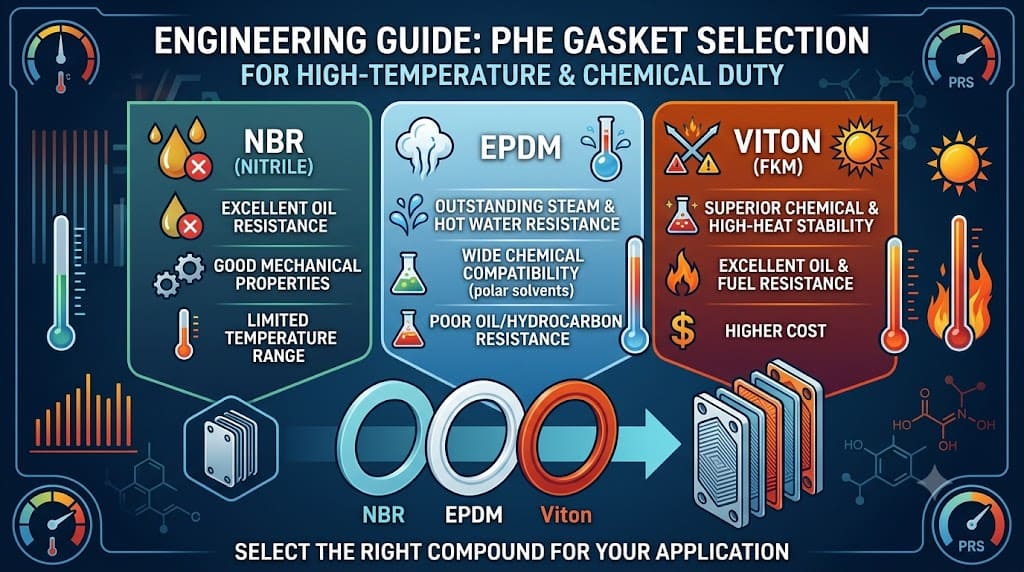
The choice between NBR, EPDM, and Viton (FKM) depends on continuous operating temperature and chemical compatibility. NBR works best for oils up to 110°C.1 EPDM handles steam and water up to 150°C.2 Viton resists harsh chemicals up to 200°C.3 Do not rely on peak temperature limits alone.
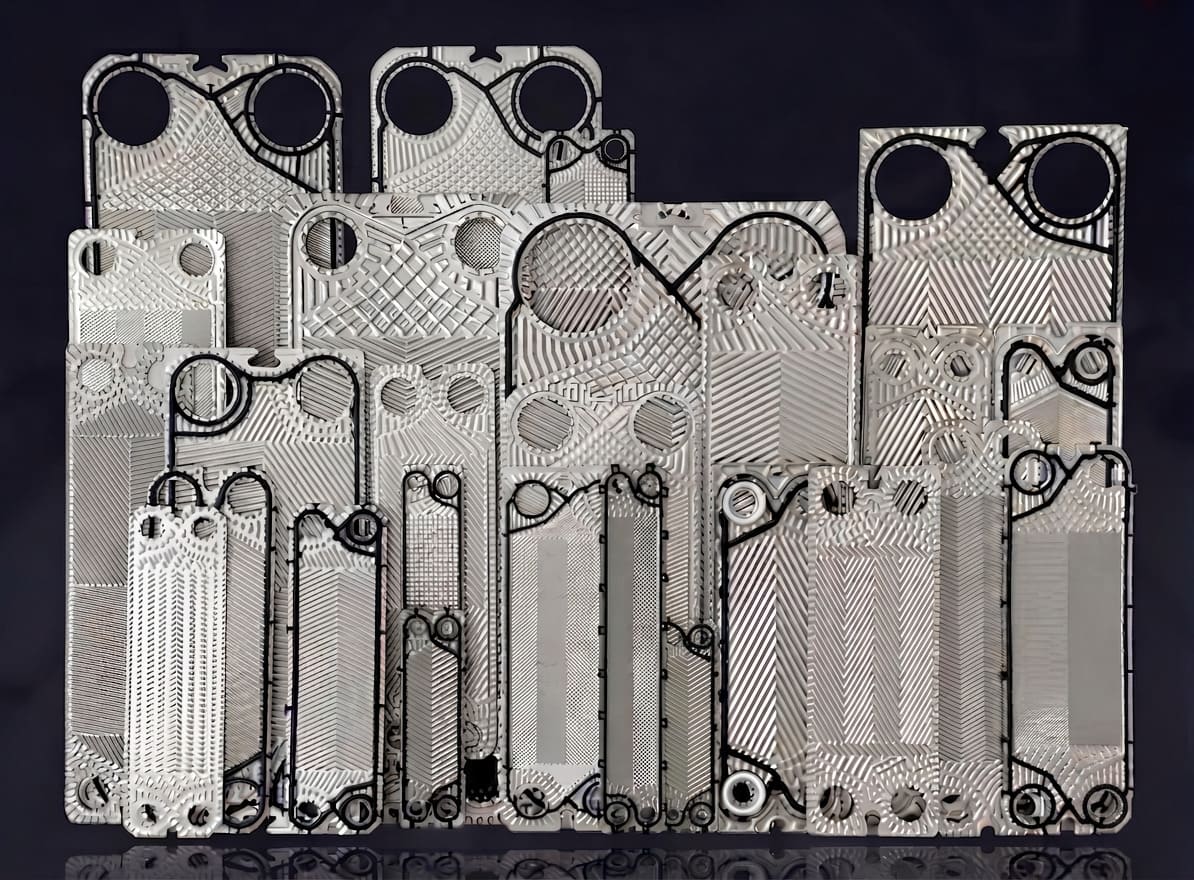
I remember a panic call from a plant manager in Saudi Arabia. His palm oil refinery shut down because his new gaskets failed in just three months. He bought cheap parts based on a paper catalog limit. I see this mistake often. You must look past the basic temperature ratings. If you stop reading now, you might buy the wrong gaskets again and face another costly shutdown.
Why do peak temperature limits cause gasket failure?
Many suppliers sell gaskets based on peak temperature limits. You buy them. They harden and fail in months. You need to know the real continuous limits.
Peak limits like 150°C for EPDM or 120°C for NBR only show instant survival. For long life, use continuous operating temperatures. High heat causes over-crosslinking in rubber molecules.4 This destroys the elastic memory.
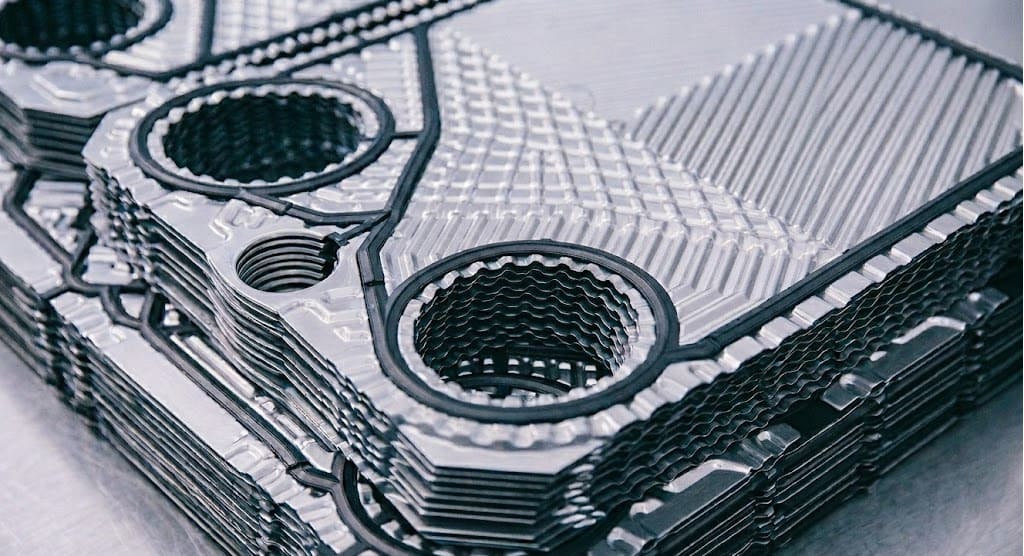
I always tell my buyers that compression set is the real key to gasket life. Most suppliers only show you the flash point. They say NBR can reach 120°C. If you run your system at 120°C every day, the rubber molecules break. The heat speeds up the crosslinking process. We call this over-crosslinking. The gasket becomes hard and brittle. It loses its bounce. It stays flat forever. This permanent flat shape is the compression set.
You must aim for a low compression set. When the gasket stays flat, water or oil leaks out. Let us look at the real continuous limits you should use. We test every batch at our factory. We measure the compression set. We do not guess.
Real Temperature Limits for Daily Use
| Material | Supplier Peak Limit | Real Continuous Limit | Result of Overheating |
|---|---|---|---|
| NBR | 120°C | 100°C - 110°C | Embrittlement and cracking |
| EPDM (Peroxide) | 160°C | 140°C - 150°C | Hardening over time |
| Viton (FKM) | 220°C | 180°C - 200°C | Hydrolysis in hot steam |
I saw a client ruin a whole batch of NBR gaskets. They ran the system at 115°C for weeks. The rubber cracked like dry wood. We changed their system to use high-grade EPDM. The leaks stopped. You must match your daily running temperature to the continuous limit. You must ignore the peak limit.
How does chemical compatibility decide your PHE gasket choice?
You choose a gasket that handles the heat. But the fluid eats the rubber. Your factory floor floods. Chemical matching stops this disaster.
NBR is a polar rubber. It resists non-polar mineral and vegetable oils perfectly. EPDM is a non-polar rubber. It handles water and steam well but swells instantly in oil. Viton (FKM) is highly fluorinated. It blocks strong acids effectively.
Let me share a story about Ahmad. He is a maintenance head at a palm oil plant. He bought EPDM gaskets. He liked the high heat rating. He installed them. The palm oil touched the EPDM. Within hours, the EPDM gaskets soaked up the oil like a sponge. They swelled up by 30 percent. The pressure pushed the swollen rubber right out of the plate grooves. He had to stop the whole plant.
This happens because of chemical polarity. Like dissolves like. You must keep non-polar fluids away from non-polar rubber. You must know your fluids before you buy.
Chemical Matching Guide
| Gasket Material | Best Fluids (Safe to Use) | Worst Fluids (Do Not Use) |
|---|---|---|
| NBR (Polar) | Mineral oil, vegetable oil, hydrocarbons | Strong acids, polar solvents |
| EPDM (Non-Polar) | Hot water, steam, acid/alkali CIP fluids | Fats, animal oils, mineral oils |
| Viton / FKM | Strong acids, oxidizers, aromatics | High-temp steam, strong alkalis |
Viton is very strong against acids. It has high fluorine content. But beware of hot steam. Hot steam causes hydrolysis in Viton.5 The water breaks the main molecule chain. If you clean your system with hot steam, Viton will fail. EPDM is the clear winner for steam and hot water applications. NBR remains the king for any oil duties.
Why does the curing process matter for EPDM gaskets?
You buy EPDM gaskets. They fail at 120°C. You feel confused because EPDM should handle 150°C. The hidden curing method caused your problem.
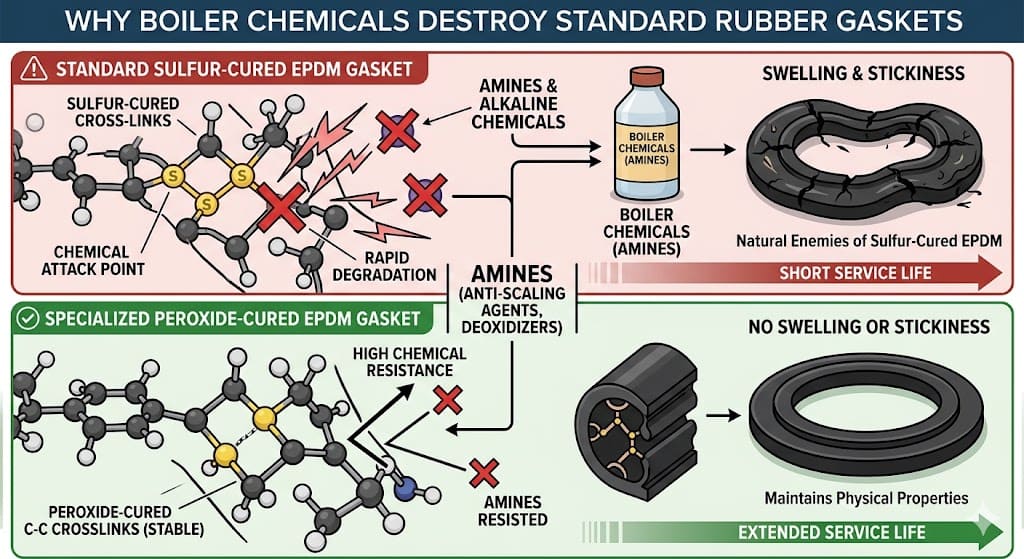
Cheap EPDM uses sulfur curing. The carbon-sulfur bonds break easily at high temperatures. High-quality EPDM uses peroxide curing. This creates strong carbon-carbon bonds. Peroxide-cured EPDM keeps its elastic pull for years under hot and cold thermal cycling.
I visit many factories. I see buyers choose the cheapest EPDM gasket on the market. They do not know about the curing process. Curing is how we bake the rubber. Curing makes the rubber strong.
Sulfur-cured EPDM is cheap. It is easy to make. But the chemical bond is a Carbon-Sulfur bond. This bond has low energy. When the heat goes above 120°C, the bond breaks. The gasket goes flat. It never recovers.
At TIVO, we use peroxide-cured EPDM for high demands. Peroxide curing makes a Carbon-Carbon single bond.6 This bond has very high energy. It fights heat. It gives a very low compression set. The compression set stays under 20 percent even after 100 hours of extreme heat.
Comparing Curing Methods
| Curing Method | Bond Type | Heat Resistance | Best Application |
|---|---|---|---|
| Sulfur Cured | Carbon-Sulfur | Up to 120°C | Low-cost, low-temp water |
| Peroxide Cured | Carbon-Carbon | Up to 150°C | High-temp steam, thermal cycling |
If your system heats up and cools down often, you have thermal cycling. Sulfur-cured rubber will crack under this stress. Peroxide-cured rubber will stretch and bounce back. Always ask your supplier how they cure their EPDM. It changes everything.
How do cheap fillers destroy your heat exchanger gaskets?
Some gaskets look fine but break apart quickly. Cheap makers hide bad materials inside. Your clean process gets dirty. You face ruined products.
Low-cost suppliers add too much carbon black or calcium carbonate to save money. These cheap fillers increase extractables that pollute food and pharma products. They also make the rubber weak. The rubber cracks easily when the metal plates expand.
I once met a food processor. He found black spots in his milk. His cheap gaskets leaked chemicals into the milk. This is a nightmare for any plant manager. The problem comes from the rubber mix.
Good rubber needs some fillers to be strong. But bad factories want to save money. They put too much carbon black in the mix. They add cheap calcium carbonate. Some even mix in old, recycled rubber.
This bad mix causes two huge problems. First, the extra chemicals wash out into your fluid. We call this high extractables. You cannot use this in food or medicine plants. Second, the rubber loses its stretch. When your heat exchanger gets hot, the metal plates grow. When it cools, the plates shrink. The gasket must move with the plates. A gasket full of cheap chalk will just crack open.
The Impact of Bad Fillers
| Problem Source | Direct Result | Factory Impact |
|---|---|---|
| Excess Carbon Black | Stiff rubber | Cracks during thermal expansion |
| Calcium Carbonate | Chalky texture | Poor pressure holding |
| Recycled Rubber | High extractables | Fluid contamination |
At TIVO, we use pure material recipes. We do full spectral testing on all materials. We do this to ensure your food stays safe. We do this to ensure your factory stays clean. You must demand pure rubber.
Conclusion
Never choose gaskets by peak limits alone. Match NBR, EPDM, or Viton to your real continuous heat and chemicals. Demand pure, properly cured rubber to stop leaks forever.7
"The Influence of Oil and Thermal Aging on the Sealing ... - PMC - NIH", https://pmc.ncbi.nlm.nih.gov/articles/PMC11397856/. This source provides a detailed analysis of NBR's thermal and chemical properties, confirming its suitability for oils at temperatures up to 110°C. Evidence role: expert_consensus; source type: research. Supports: NBR is suitable for oils up to 110°C due to its thermal and chemical properties.. Scope note: The data may vary slightly depending on specific NBR formulations. ↩
"Which Rubber Materials Can Resist High Temperatures?", https://epdm.co.uk/which-rubber-materials-can-resist-high-temperatures/. This source discusses EPDM's resistance to steam and water at high temperatures, supporting its use up to 150°C. Evidence role: expert_consensus; source type: research. Supports: EPDM is effective for steam and water applications at temperatures up to 150°C.. Scope note: Performance may depend on the curing method used for EPDM. ↩
"Viton™ Product Selection Guide | Viton™ Fluoroelastomers", https://www.viton.com/en/products/product-selection. This source confirms Viton's chemical resistance and thermal stability, supporting its use in harsh chemical environments up to 200°C. Evidence role: expert_consensus; source type: research. Supports: Viton is suitable for harsh chemical environments at temperatures up to 200°C.. Scope note: Specific chemical resistance may vary depending on the formulation of Viton. ↩
"Correlation between the Crosslink Characteristics and Mechanical ...", https://pmc.ncbi.nlm.nih.gov/articles/PMC7565785/. This source explains the molecular effects of high heat on rubber, including over-crosslinking and its impact on elasticity. Evidence role: mechanism; source type: education. Supports: High heat leads to over-crosslinking in rubber molecules, reducing elasticity and causing failure.. Scope note: The explanation may vary for different types of rubber compounds. ↩
"Use of Viton (FKM/FPM) with hot water or steam service | Eng-Tips", https://www.eng-tips.com/threads/use-of-viton-fkm-fpm-with-hot-water-or-steam-service.125481/. This source explains the chemical process of hydrolysis in Viton when exposed to hot steam, confirming its vulnerability. Evidence role: mechanism; source type: research. Supports: Hot steam induces hydrolysis in Viton, breaking molecular chains and reducing durability.. Scope note: The degree of hydrolysis may depend on steam temperature and duration of exposure. ↩
"Combined Sulfur and Peroxide Vulcanization of Filled and Unfilled ...", https://pmc.ncbi.nlm.nih.gov/articles/PMC10456314/. This source details the chemical bonding in peroxide-cured EPDM, confirming the formation of strong Carbon-Carbon single bonds. Evidence role: mechanism; source type: education. Supports: Peroxide curing creates strong Carbon-Carbon single bonds in EPDM, enhancing heat resistance.. Scope note: The bond strength may vary slightly depending on curing conditions. ↩
"Impact of Base Rubber and Cure Systems in Additive Manufacturing ...", https://pmc.ncbi.nlm.nih.gov/articles/PMC12944680/. This source emphasizes the importance of using pure and properly cured rubber to ensure gasket reliability and prevent leaks. Evidence role: general_support; source type: education. Supports: Using pure and properly cured rubber significantly reduces the risk of gasket leaks.. Scope note: The effectiveness may depend on specific application conditions. ↩