Are your heat exchangers leaking steam after a few months? Frequent gasket failures1 cost you money and time. EPDM-Peroxide cured gaskets2 offer the exact solution you need.
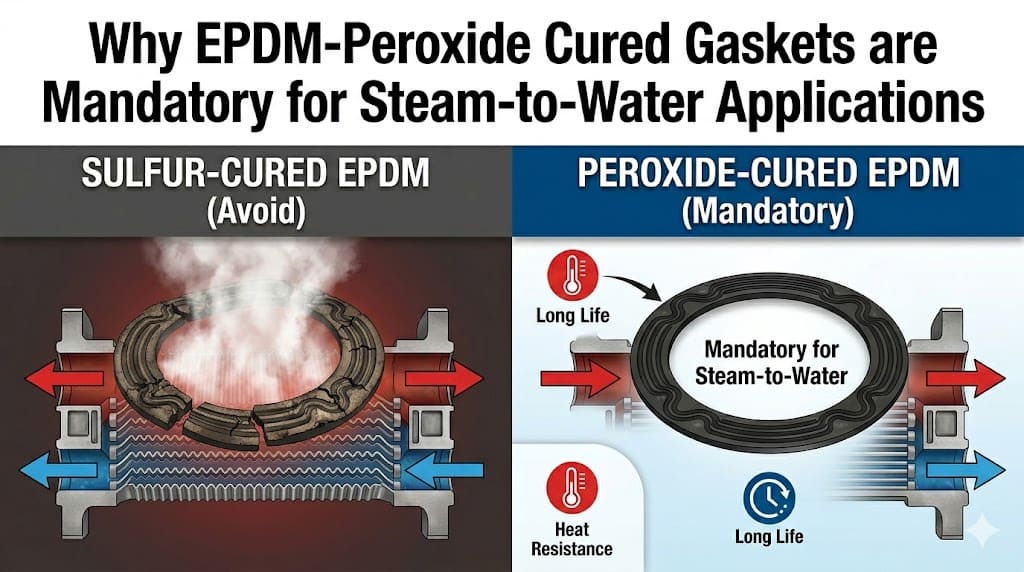
EPDM-Peroxide cured gaskets are mandatory for steam applications3. They use strong carbon-carbon bonds4. These bonds resist high heat, chemical amines, and thermal expansion. This structure prevents hardening, stops cold leakage5, and ensures long-term sealing in steam-to-water heat exchangers6.
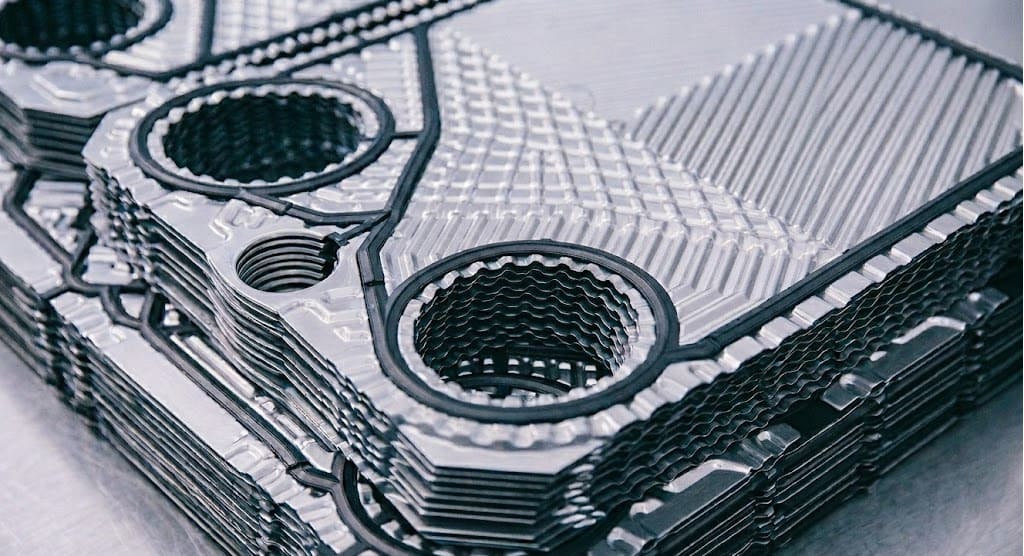
Many maintenance managers think all EPDM rubber is the same. You will ruin your equipment quickly if you choose the wrong curing method. I will show you exactly why standard gaskets fail in steam systems. You must change your approach today.
How Does the Molecular Structure Survive High-Temperature Steam?
High heat attacks rubber at the basic molecular level. Standard rubber breaks down fast. Peroxide curing builds a much stronger defense against this intense heat.
Standard EPDM uses a sulfur curing process7. This process creates weak sulfur bridges. High-temperature steam breaks these weak bonds easily. TIVO’s EPDM-Peroxide gaskets form strong carbon-carbon bonds. These stronger bonds resist the thermal shear of hot steam. The gasket stays flexible and intact.
I have seen many failed gaskets in my 15 years in the heat exchanger industry. The main problem is a chemical process. We call this process sulfur reversion8. Standard EPDM rubber uses sulfur. The sulfur links the rubber molecules together. These sulfur bridges are very weak. You expose them to high-pressure steam9. The intense heat breaks the bonds. The molecules rearrange themselves. The rubber loses its natural elasticity. The gasket becomes hard. It becomes very brittle. The gasket will crack. The system will fail.
We solve this problem at TIVO. We use a peroxide curing process. This process does not use sulfur. It creates carbon-carbon bonds instead. A carbon-carbon bond has a very high energy level. You need much more heat to break it. You need much more force to break it. This strong structure resists the thermal shear of hot steam. The rubber keeps its original shape. The rubber keeps its bounce.
| Feature | Sulfur-Cured EPDM | Peroxide-Cured EPDM |
|---|---|---|
| Bond Type | Sulfur Bridges (S-S) | Carbon-Carbon (C-C) |
| Bond Strength | Weak | Very Strong |
| Heat Resistance | Poor | Excellent |
| Result in Steam | Becomes brittle and cracks | Stays flexible and tight |
This molecular difference is the first reason. You must use peroxide-cured EPDM for any steam-to-water application. You cannot fight basic chemistry.
Why Do Boiler Chemicals Destroy Standard Rubber Gaskets?
Steam is almost never pure water. Boilers use harsh chemicals to clean the water. These hidden chemicals will eat standard rubber gaskets alive.
Boiler steam contains amines. These amines act as anti-scaling agents and deoxidizers. These alkaline chemicals are natural enemies of sulfur-cured EPDM. They speed up the degradation of the rubber. Peroxide-cured EPDM has high chemical stability10. It resists these amines without swelling or getting sticky.
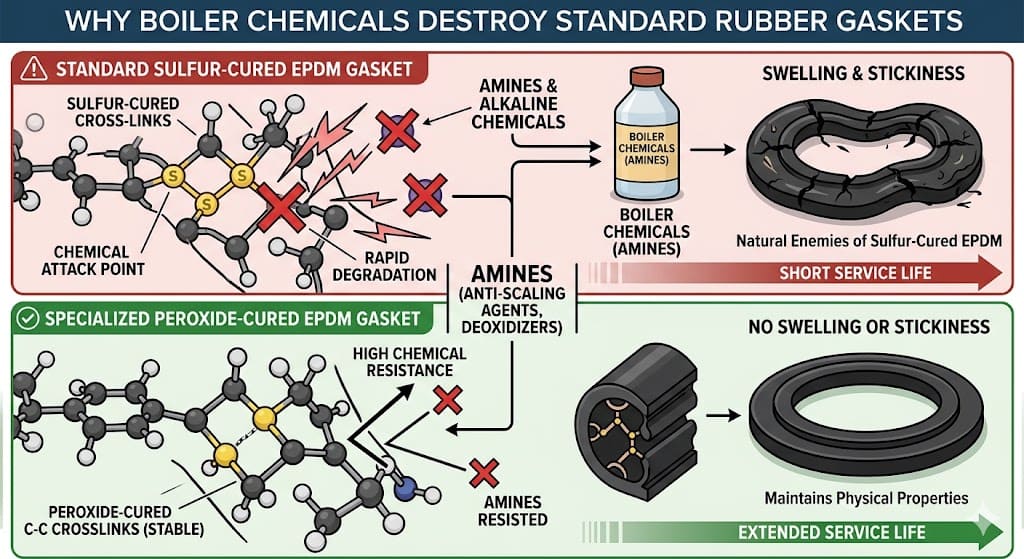
Many plant managers forget about the chemicals in their steam lines. Boiler water needs chemical treatment. This treatment stops scale and rust. Plant operators add amines to the water. These amines remove oxygen. The amines travel with the steam. They go directly into your heat exchanger.
You face a big problem. You use standard sulfur-cured EPDM. Amines are highly alkaline chemicals. They aggressively attack the sulfur bonds in the rubber. I once visited a large palm oil refinery. The maintenance head was a man named Ahmad. Ahmad showed me his ruined gaskets. The rubber turned into a sticky paste. The paste was black. The amines literally melted the standard EPDM.
Our TIVO EPDM-Peroxide gaskets11 do not react to these alkaline chemicals. The carbon-carbon bonds4 do not care about amines. The rubber will not swell. The rubber will not become sticky. The sealing surface stays completely intact.
| Chemical Hazard | Effect on Sulfur EPDM | Effect on Peroxide EPDM |
|---|---|---|
| Amines (Alkaline) | Melts the rubber | No reaction |
| Deoxidizers | Causes severe swelling | Maintains original size |
| Chemical Stability | Very Low | Very High |
You must protect your gasket from chemical attacks. Peroxide curing gives you this vital chemical shield. You need this shield in steam applications3.
How Can You Stop Cold Leakage During Thermal Cycling?
Steam systems turn on and off all the time. This constant heating and cooling causes metal plates to move. Your gasket must bounce back.
Thermal cycling causes standard sulfur-cured gaskets to suffer permanent plastic deformation. They lose their compression set12. This causes cold leakage when the system cools down. TIVO’s peroxide-cured EPDM maintains strong rebound force above 150 degrees Celsius. This prevents cold leaks during frequent startups and shutdowns.
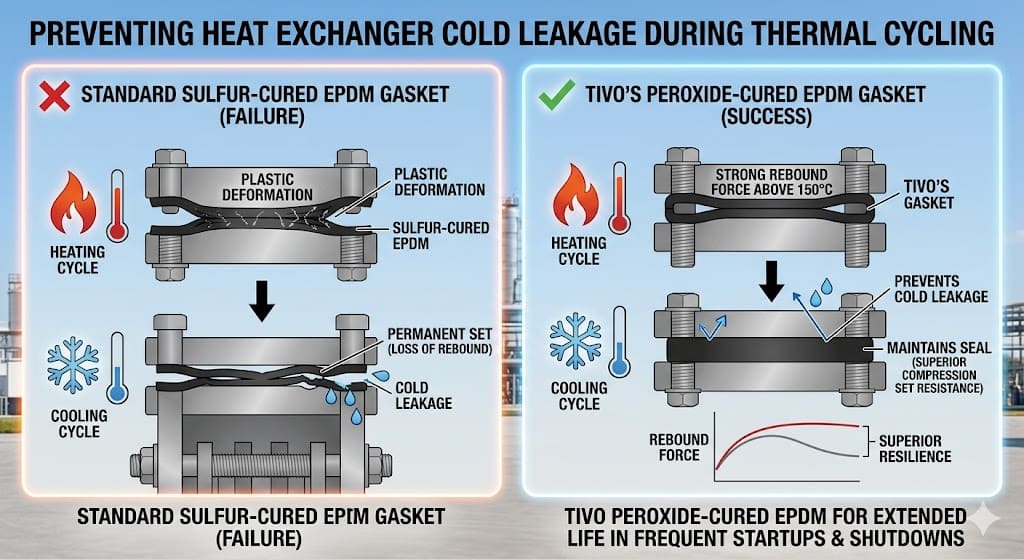
A steam-to-water heat exchanger does not run at a constant temperature. The system starts up in the morning. The system shuts down at night. We call this process thermal cycling13. Steam enters the heat exchanger. The metal plates get hot. The metal plates expand. The system stops later. The metal cools down. The metal shrinks.
Your gasket sits between these moving metal plates. It must have an excellent compression set12. The gasket must compress when the plates squeeze it. The gasket must bounce back when the pressure drops. Heat ruins a standard sulfur-cured gasket. The gasket flattens out. The gasket stays flat. We call this permanent plastic deformation. The heat exchanger cools down. The metal shrinks away from the flat gasket. This action creates a gap. Water and steam leak out. We call this cold leakage.
TIVO uses the peroxide curing process. This process solves this exact issue. Our gaskets maintain their memory. They keep their shape. The temperature goes above 150 degrees Celsius. The rubber still keeps its bounce.
| Condition | Sulfur-Cured EPDM | Peroxide-Cured EPDM |
|---|---|---|
| High Heat Phase | Flattens permanently | Bounces back |
| Cool Down Phase | Leaves a gap | Expands to seal the gap |
| Leakage Result | Severe Cold Leakage | No Leakage |
You want a maintenance-free heat exchanger14. You must eliminate cold leakage. Peroxide-cured rubber is the only way. It achieves a tight seal during thermal shifts.
Why Is Hardness Stability Crucial for Long-Term Sealing?
A gasket must press hard against the metal plates. It keeps the steam inside. The seal will fail quickly if the rubber changes its hardness.
Standard EPDM hardens by 10 to 15 degrees after three months in hot steam. This lowers the sealing pressure. Steam escapes easily. Peroxide-cured EPDM has very little hardness fluctuation. It provides constant sealing pressure. It blocks high-pressure steam over its entire lifespan.
Sealing high-pressure steam requires steady pressure from the gasket. The rubber must push back against the metal plates. It must push with a specific force. We call this force sealing pressure. The rubber gets too hard sometimes. It cannot press firmly into the small grooves of the metal plate.
Standard sulfur-cured EPDM fails this test. The rubber runs in a steam application for three months. The rubber bakes in the heat. Its hardness level goes up by 10 to 15 degrees. The rubber turns into a hard plastic ring. The rubber becomes too hard. The sealing pressure drops. High-pressure steam pushes right past the hard gasket. The steam washes the gasket away.
I speak with many EPC project managers. I always tell my client Sergey to check the hardness stability15 of his rubber. TIVO’s peroxide-cured EPDM keeps a very stable hardness level. It maintains this level for its whole life. It does not bake in the steam. It does not get hard.
| Time in Steam | Sulfur EPDM Hardness | Peroxide EPDM Hardness |
|---|---|---|
| Day 1 | Normal | Normal |
| Month 3 | +15 Degrees (Hard) | Stable |
| Sealing Pressure | Drops significantly | Remains constant |
The rubber stays flexible. It continues to provide a constant pressure. It provides strong sealing pressure. This steady pressure stops the high-pressure steam. The steam cannot wash out the seal. You get a much longer lifespan from your equipment.
Conclusion
EPDM-Peroxide cured gaskets use strong carbon bonds to resist heat. They fight chemicals, stop cold leaks, and keep constant pressure. You must use them for steam-to-water heat exchangers.
Learn about the common causes of gasket failures and how to prevent them in steam systems. ↩
Explore the advantages of EPDM-Peroxide gaskets for steam applications and how they outperform standard gaskets. ↩
Learn why EPDM-Peroxide gaskets are essential for steam applications and how they enhance performance. ↩
Discover the significance of carbon-carbon bonds in gaskets and their role in durability and performance. ↩
Find effective strategies to prevent cold leakage in heat exchangers and maintain system integrity. ↩
Learn about steam-to-water heat exchangers and the importance of using the right gaskets. ↩
Gain insights into the sulfur curing process and its limitations in high-temperature applications. ↩
Learn about sulfur reversion and its detrimental effects on rubber gaskets in steam systems. ↩
Discover the challenges high-pressure steam poses to gasket sealing and how to overcome them. ↩
Understand the importance of chemical stability in rubber gaskets and how it affects longevity. ↩
Discover the unique features of TIVO EPDM-Peroxide gaskets and their advantages over standard options. ↩
Explore the concept of compression set and its impact on gasket performance in dynamic applications. ↩
Explore the concept of thermal cycling and its implications for gasket performance in steam systems. ↩
Find out how to create a maintenance-free heat exchanger with the right gasket materials. ↩
Explore the concept of hardness stability and its critical role in maintaining effective sealing. ↩