
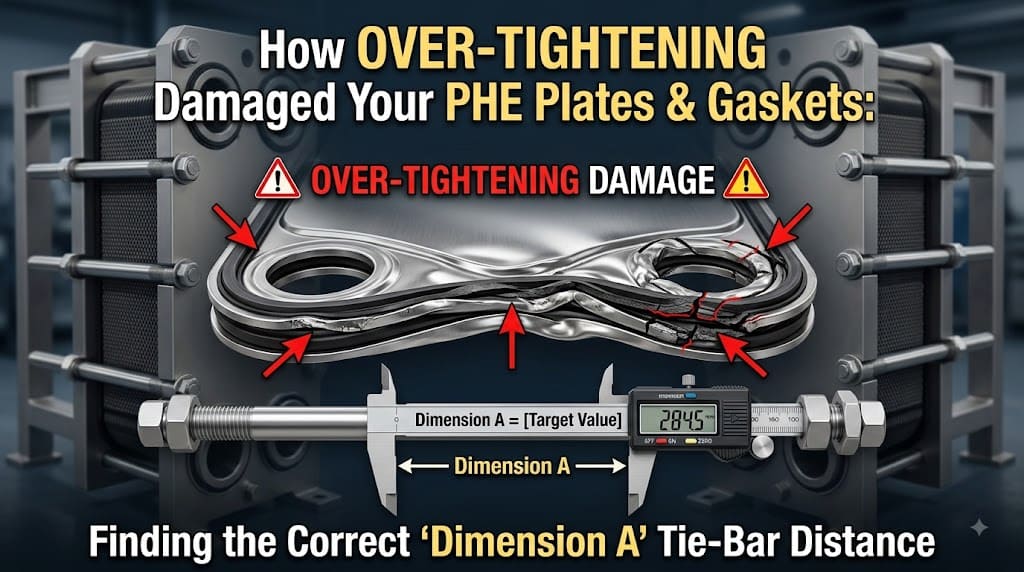
Your heat exchanger leaks. You tighten the bolts more. But the leak gets worse. Stop right there. Over-tightening destroys your plates and gaskets.1 Let us fix this problem together.
The correct "Dimension A" tie-bar distance ensures proper gasket compression. Over-tightening causes rubber plastic deformation and metal plate buckling. You must never tighten beyond the recommended Dimension A to stop leaks. Sealing relies on rubber elasticity. It does not rely on metal-to-metal crushing pressure.
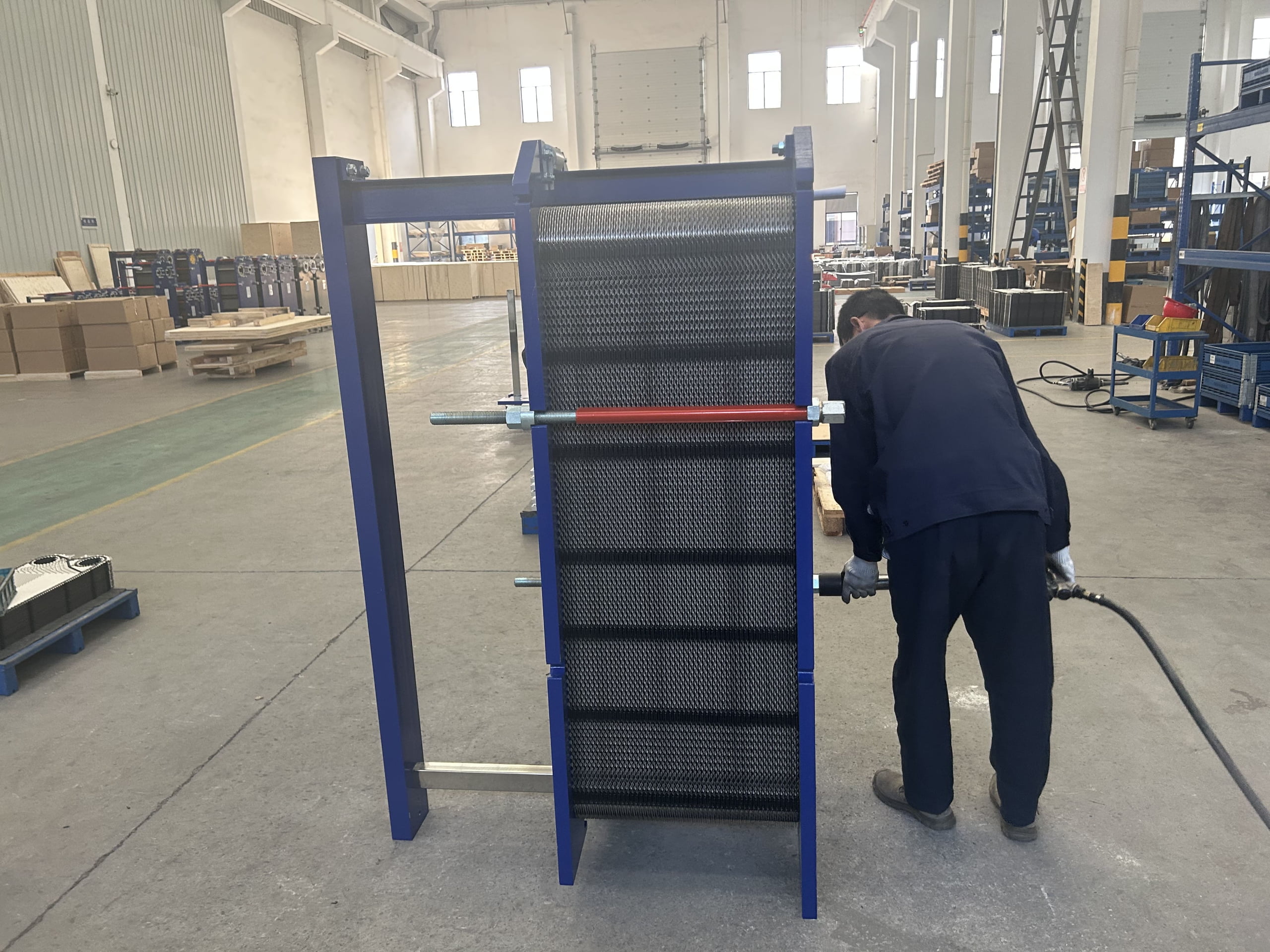
I see this mistake all the time in our factory and during field visits. A leak happens. Maintenance teams grab a wrench. They pull the tie-bars as hard as they can. They think more pressure means a tighter seal. But this is completely wrong. You will ruin your equipment if you do this. You will spend thousands of dollars on replacement parts. I want to show you exactly what happens inside your heat exchanger when you tighten it too much.
Why Does Over-Tightening Destroy Gasket Elasticity?
Do you think tighter bolts make better seals? This belief actually causes massive leaks. Rubber loses its shape under too much pressure.2 Let us look at gasket elastic memory.
Every plate and gasket has a fixed compression range.3 You might tighten past this critical point. The rubber enters plastic deformation. It loses its elastic memory completely. The gasket cannot push back against the plates. This leads to severe explosive leaks.
A plate heat exchanger seals because the rubber gasket pushes back against the metal plate. We call this elastic deformation. The seal relies on this flexible push.4 It does not rely on hard, dead pressure between metal parts. Every gasket model we make at JIANGYIN TIVO TECHNOLOGY has a specific design limit.
When you tighten the tie-bars too much, you push the rubber past its safe limit. The rubber stops being flexible. It enters a state called plastic deformation. You can think of a metal spring. If you pull a spring too hard, it stays stretched. It never goes back to its normal shape. The same thing happens to your rubber gaskets.
Once the elastic memory is gone, the gasket is dead. It cannot adapt to temperature changes in your system. It cannot handle pressure shocks. Instead of fixing a small drip, your over-tightening creates a massive gap. The fluid will suddenly burst out of the heat exchanger. This explosive leak is very dangerous for your workers. It also stops your entire production line. You must always respect the correct Dimension A. This keeps the rubber alive and working well.
| Material Status | Compression Level | Result on Gasket | Leak Risk |
|---|---|---|---|
| Normal | Within Dimension A | Keeps elastic memory | Very Low |
| Over-tightened | Below Dimension A | Plastic deformation | High (Explosive) |
How Does Excessive Pressure Cause Plate Groove Buckling?
You might think metal plates are too strong to break. But thin plates bend easily under extreme pressure. This ruins the sealing groove. Here is how groove buckling happens.
When tightening force is too high, hard gaskets create concentrated shear stress on the metal. This stress pushes into the bottom of the sealing groove. It causes thin plates to buckle and deform. This destroys the plate permanently.
Many of our customers manage large chemical processing plants. They use hard gaskets for harsh fluids. A common choice is Viton. It has a hardness of 80 Shore A. These gaskets are very hard. They do not compress easily. You might apply too much force on the tie-bars. When you do this, the hard rubber acts like a solid tool. It presses directly into the metal.
Our heat exchanger plates are typically very thin. They are usually 0.5mm or 0.6mm thick. We design them this way to transfer heat quickly. We want them to be efficient. But this thin metal cannot survive concentrated shear stress. The hard gasket pushes directly into the bottom of the sealing groove.5 The metal cannot hold this force. So, it bends and sinks. We call this groove buckling.
Once the groove buckles, the plate becomes garbage. You cannot hammer it back into shape. The precise geometry is gone forever. You might put a brand new gasket into a buckled groove. It will still not seal. The fluid will find the deformed gaps. It will leak out. You must measure Dimension A carefully. This is very important when you use hard gasket materials in high-pressure systems.
| Plate Thickness | Gasket Hardness | Risk of Buckling |
|---|---|---|
| 0.5mm | 80 Shore A | Very High |
| 0.6mm | 70 Shore A | Medium |
What is Contact Point Collapse and How Does it Increase Pressure Drop?
Are your pumps working harder than usual? Over-tightening crushes the internal structure of your plates.6 This blocks fluid flow and costs you money. Let us explore contact point collapse.
Adjacent plates support each other at their corrugation crests.7 Over-tightening causes these support points to yield and collapse. This makes the flow channels narrow. It hugely increases the system pressure drop. It also makes it impossible to reassemble the plates later.
Inside a gasketed plate heat exchanger, the plates do not just hang in the air. The metal has wavy patterns. We call these patterns corrugation crests. These crests touch each other. These touching points support the whole plate pack. They create the open channels. Your water, oil, or chemical flows through these channels.
You might tighten the unit beyond the correct Dimension A. When you do this, you put crushing weight on these tiny support points. The metal cannot hold the extra weight. The crests suffer local yielding deformation. They flatten out. We call this contact point collapse. When the points flatten, the space between the plates gets very small.
This narrow space creates a huge problem for your pumps. The fluid has to fight hard to get through the crushed channels. Your system pressure drop goes up very fast. You will waste a lot of electricity. Your pumps will try to push fluid through a blocked machine. Also, once these points collapse, the plates lose their alignment. You might open the heat exchanger for cleaning later. You will never be able to put those crushed plates back together. They will not fit. You will have to buy a whole new set of plates.
| Dimension A Status | Flow Channel | Pressure Drop | Reassembly |
|---|---|---|---|
| Correct | Open | Normal | Easy |
| Crushed | Narrow | Very High | Impossible |
Why Do Gaskets Squeeze Into Flow Channels or Lose Their Clips?
Do you see rubber pieces inside your pipes? Too much pressure destroys gasket attachments. This blocks your media and ruins the seal. Discover how lateral stress breaks gaskets.
Over-tightening changes axial stress into lateral squeezing stress.8 The metal edge cuts off the rubber prongs for clip-on gaskets.9 The glue layer peels away for glue-on gaskets.10 Soft rubber gets squeezed directly into the plate flow channels. This blocks the fluid.

You apply force in a straight line when you tighten the tie-bar nuts. We call this axial stress. But the plates eventually cannot move any closer together. That straight force has to go somewhere else. It turns into lateral stress. This means the force pushes the rubber sideways.
This sideways pushing is terrible for your gaskets. You might use clip-on gaskets. The rubber prongs hold the gasket to the plate. The lateral stress pushes the prongs against the sharp metal edges of the plate. The metal cuts the clips right off. You might use glue-on gaskets instead. The sideways force rips the rubber away from the glue layer. The glue peels off.
The situation is even worse if you use soft rubber. A good example is 70 Shore A EPDM. The soft rubber cannot fight the sideways pressure. It squishes out of the sealing groove. It pushes directly into the fluid flow channel. This blocks the passage for your media. You will get terrible heat transfer. The fluid cannot reach all parts of the plate. You must always check the manual for Dimension A. This keeps the rubber safely inside its groove.
| Gasket Type | Rubber Hardness | Damage from Over-tightening |
|---|---|---|
| Clip-on | High or Low | Prongs cut by metal edge |
| Glue-on | High or Low | Glue layer peels off |
| Any | Low (e.g., 70 Shore A) | Squeezes into flow channel |
What is the Scissoring Effect and Why is it Dangerous?
Are you tightening one bolt at a time? This uneven pulling tilts the heavy metal plates. It creates dangerous traps and breaks the machine. Learn about the scissoring effect.
You might tighten one side too much. The pressure plate tilts and creates a Scissoring Effect.11 One side gets crushed. The other side leaks. The hanger angle bites into the top guide bar. This causes severe equipment damage and creates major human safety risks.
You must tighten all the tie-bars evenly when you adjust Dimension A. Sometimes, a maintenance worker will tighten the left side completely. They do this before they touch the right side. This is a very bad mistake. The heavy steel pressure plate will tilt. We call this the Scissoring Effect.
The plate is tilted. So, the left side of the plate pack gets crushed. The gaskets and plates on that side suffer all the damage. We talked about this damage earlier. But the right side is still loose. So, it leaks heavily. You get the worst of both worlds.
This is also very dangerous. The tilted pressure plate gets stuck. The hanger angle sits at the top of the plate. It will bite hard into the top guide bar. The metal scrapes and locks together. A worker might try to force it open or closed. The tension can release suddenly. Heavy steel parts can swing or snap. This is a massive safety hazard for your team. It also damages the guide bar. The guide bar is very expensive to replace. You must always tighten bolts in a star pattern. You must measure Dimension A on all sides. This keeps the plate straight.
| Action | Result on Pressure Plate | Safety Risk |
|---|---|---|
| Tighten evenly in star pattern | Plate stays straight | Low |
| Tighten one side completely | Plate tilts (Scissoring Effect) | Very High |
Conclusion
Never over-tighten your heat exchanger to stop a leak. Respect Dimension A to prevent plastic deformation, plate buckling, and channel collapse. Proper tightening saves your equipment and ensures safety.
"Calculation Model of Mechanical and Sealing Properties of NiTi Alloy ...", https://pmc.ncbi.nlm.nih.gov/articles/PMC9267744/. Over-tightening can lead to damage in heat exchanger plates and gaskets due to excessive stress, as documented in engineering studies on material deformation. Evidence role: mechanism; source type: research. Supports: Over-tightening damages heat exchanger plates and gaskets.. Scope note: Specific studies may focus on certain gasket materials or plate designs. ↩
"Uniaxial Extension and Compression in Stress-Strain Relations of Rubber", https://pmc.ncbi.nlm.nih.gov/articles/PMC6751957/. Excessive pressure can cause rubber to enter plastic deformation, losing its elastic properties, as explained in material science research. Evidence role: mechanism; source type: research. Supports: Rubber loses its shape under excessive pressure.. Scope note: Findings may vary based on rubber type and application conditions. ↩
"Heat Exchanger Gaskets: Tips for Safety & Performance", https://blog.chesterton.com/sealing/heat-exchanger-gaskets-tips/. Heat exchanger plates and gaskets are designed with specific compression ranges to ensure proper sealing, as outlined in engineering manuals. Evidence role: definition; source type: education. Supports: Heat exchanger plates and gaskets have fixed compression ranges.. Scope note: Compression ranges may differ across manufacturers and gasket types. ↩
"[PDF] FUNDAMENTALS OF FLUID SEALING John Lewis", https://ntrs.nasa.gov/api/citations/19760012374/downloads/19760012374.pdf. The sealing mechanism in plate heat exchangers depends on the elastic deformation of gaskets, as described in fluid mechanics textbooks. Evidence role: mechanism; source type: education. Supports: Sealing in plate heat exchangers relies on gasket elasticity.. Scope note: Textbooks may generalize across gasket types and applications. ↩
"Failure Assessment of Heat Exchanger Tubes Due to ...", https://link.springer.com/article/10.1007/s11668-023-01589-9. Hard gaskets can deform sealing grooves under excessive pressure, as documented in engineering failure analysis. Evidence role: mechanism; source type: research. Supports: Hard gaskets deform sealing grooves under excessive pressure.. Scope note: Findings may vary based on specific gasket and groove designs. ↩
"Plastic Deformation of Steel Plates under High Impact Loading", https://oasis.library.unlv.edu/cgi/viewcontent.cgi?article. Excessive tightening can collapse internal plate structures in heat exchangers, as described in mechanical engineering studies. Evidence role: mechanism; source type: research. Supports: Over-tightening collapses internal plate structures in heat exchangers.. Scope note: Studies may focus on specific plate designs or materials. ↩
"Mechanical Properties and Heat Transfer Performance of Conically ...", https://pmc.ncbi.nlm.nih.gov/articles/PMC8432666/. Corrugation crests in heat exchanger plates provide structural support, as explained in heat transfer engineering literature. Evidence role: definition; source type: education. Supports: Corrugation crests in heat exchanger plates provide structural support.. Scope note: Support mechanisms may vary across plate designs. ↩
"Mechanics of Materials: Axial Load", https://www.bu.edu/moss/mechanics-of-materials-axial-load/. Excessive tightening can convert axial stress into lateral stress, causing gasket damage, as described in mechanical stress analysis. Evidence role: mechanism; source type: research. Supports: Over-tightening converts axial stress into lateral stress, damaging gaskets.. Scope note: Stress conversion effects may depend on specific tightening methods. ↩
"Symmetric and Asymmetric Semi-Metallic Gasket Cores ... - PMC", https://pmc.ncbi.nlm.nih.gov/articles/PMC12155862/. Clip-on gaskets can suffer prong damage from metal edges under excessive lateral stress, as documented in gasket design studies. Evidence role: mechanism; source type: research. Supports: Clip-on gaskets suffer prong damage from metal edges under excessive lateral stress.. Scope note: Damage mechanisms may vary based on gasket and plate designs. ↩
"Adhesive Backing for Gaskets and Pads - Stockwell Elastomerics", https://www.stockwell.com/adhesives/. Excessive lateral stress can cause glue layers in glue-on gaskets to peel away, as shown in adhesive failure studies. Evidence role: mechanism; source type: research. Supports: Excessive lateral stress causes glue layers in glue-on gaskets to peel away.. Scope note: Peeling effects may depend on adhesive type and application conditions. ↩
"Okay so I tightened the pressure plate bolts to the exact ft/lbs ... - Facebook", https://www.facebook.com/groups/subarumechanics/posts/2848830582072875/. Uneven tightening can tilt pressure plates, causing the Scissoring Effect, as described in mechanical assembly guidelines. Evidence role: mechanism; source type: education. Supports: Uneven tightening causes pressure plate tilting and the Scissoring Effect.. Scope note: Guidelines may focus on specific heat exchanger models. ↩