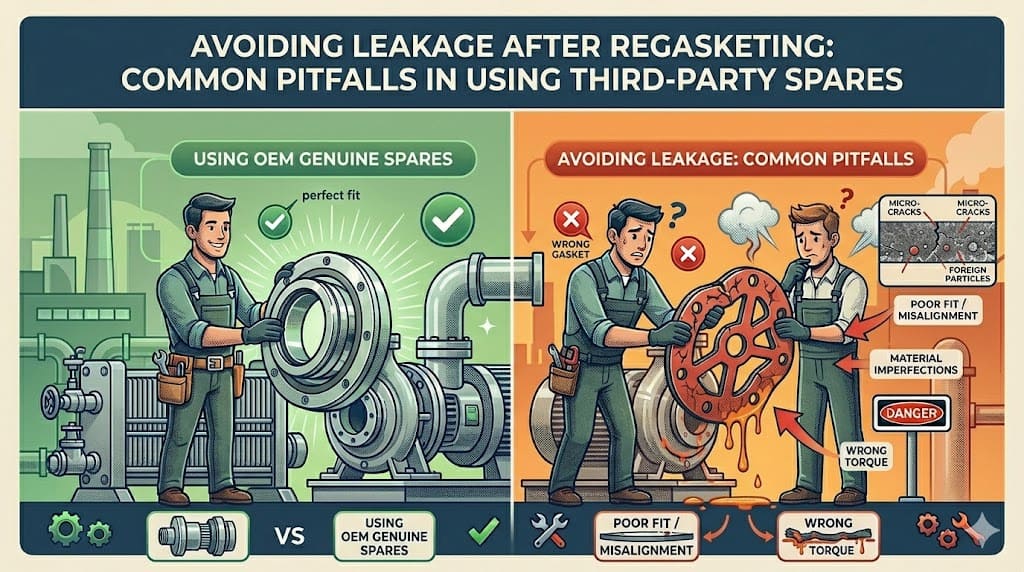
You regasket your heat exchanger, but it still leaks. Downtime costs your plant money. I will show you how to avoid these common gasket pitfalls today.
To avoid leakage after regasketing, you must use third-party spares with accurate pressing depths, precise cross-section geometries, and consistent Shore A hardness1. These factors ensure the correct A-Measurement, prevent gasket cold flow2, and stop uneven plate stress3 during tightening.

You might think all aftermarket gaskets are the same. But cheap spares hide serious flaws. These hidden flaws will ruin your maintenance efforts. Let us look at the three biggest mistakes you must avoid.
Why Does the A-Measurement Fail With Cheap Gaskets?
A small leak appears. Your first instinct is to tighten the frame. But over-tightening damages the plates. The real problem is usually a bad A-Measurement.
The A-Measurement4 fails because cheap third-party gaskets have inaccurate pressing depths. When the gasket thickness5 is wrong, the standard tightening dimension no longer works. TIVO6 provides the exact calculated A-Dimension with our spares so you achieve the best sealing pressure.
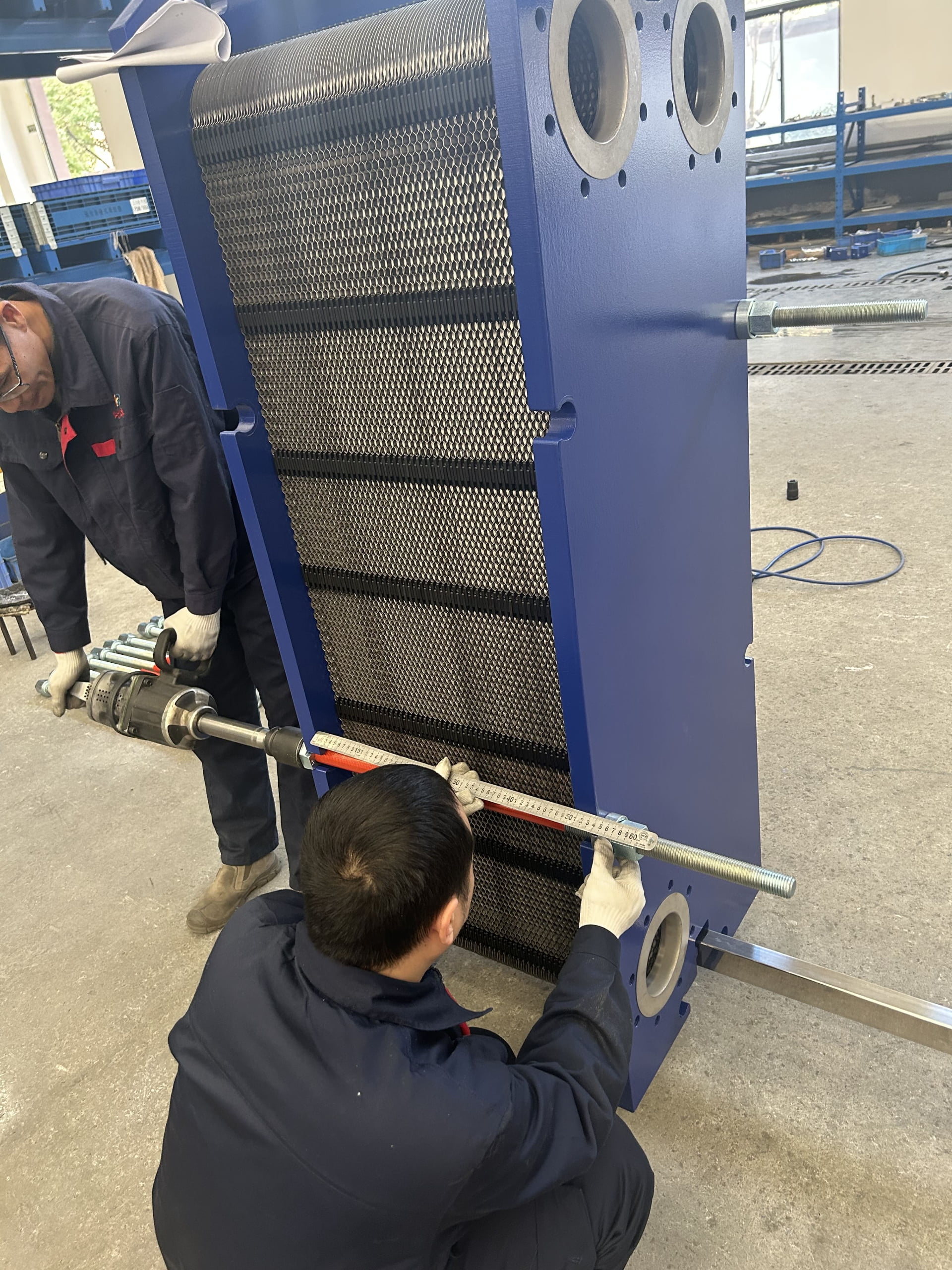
I often visit plants where maintenance workers struggle with leaking heat exchangers. They see a small drip. They grab a large wrench. They pull the metal plates closer together. They think this extra force will stop the leak. But this is a big mistake. Every gasketed plate heat exchanger has a specific A-Measurement. This measurement tells you exactly how far you should tighten the plate pack. The A-Measurement is the distance between the inside of the fixed frame plate and the inside of the movable pressure plate.
When you buy cheap third-party gaskets, the makers do not control the pressing depth7. The pressing depth is the thickness of the gasket when it sits in the plate groove. The cheap gasket might be slightly too thick. It might be slightly too thin. If the gasket is too thin, the standard A-Measurement will not create enough pressure. The rubber will not press hard enough against the metal. The unit will leak immediately. If the gasket is too thick, tightening the frame to the standard A-Measurement will crush the gasket. This extra pressure will bend and damage the expensive metal plates. You will ruin your entire equipment investment.
At TIVO, we solve this problem for you. We know that precision is everything in industrial maintenance. We test every single batch of gaskets in our factory. We measure the exact pressing depth. We provide the corresponding calculated A-Dimension for our replacement gaskets. When you install our spares, you just tighten the frame to our specified dimension. The sealing pressure becomes perfect. You do not have to guess. You protect your equipment. You stop leaks on the first try. You save a lot of time during plant shutdowns. You keep your production line running smoothly.
| Feature | Cheap Gaskets | TIVO Gaskets |
|---|---|---|
| Pressing Depth | Inaccurate | 100% Accurate |
| Tightening Guide | None | Calculated A-Dimension |
| Risk of Plate Damage | High | Very Low |
How Does Geometric Interference Cause Gasket Squeeze-Out?
You open a new box of gaskets. They look exactly like the original parts. But looking similar is not enough. The hidden danger lies in the cross-section geometry.
Geometric interference causes squeeze-out when the gasket cross-section is too wide for the plate groove. When compressed, the rubber suffers from cold flow and pushes out of the groove. If the gasket is too narrow, it fails to seal. TIVO uses reverse-engineered molds8 to prevent this.
I once met a palm oil refinery manager named Ahmad. He bought cheap replacement plates and gaskets to save his maintenance budget9. During his plant startup, the heat exchanger reached full pressure. Suddenly, the gaskets popped out of the plate grooves. Hot fluid sprayed everywhere. He had to shut down the whole processing line. He lost a lot of money that day. He learned a hard lesson about geometric interference10.
The gasket and the sealing groove must fit perfectly together. This fit determines the compression rate. Cheap gasket makers only copy the basic shape of the gasket. They ignore the exact width. They ignore the exact angle of the gasket cross-section. Rubber is a very special material. When you press it, the total volume does not change. It just changes shape. If the gasket is too wide, it has nowhere to go when you tighten the plates. The rubber acts like a thick liquid under high pressure. We call this cold flow. The pressure simply pushes the rubber out of the groove side.
If the gasket is too narrow, the situation is also bad. The rubber does not touch the sides of the groove. It cannot block the fluid properly. We do things very differently at TIVO. We use original factory reverse-engineering molds. We scan the original brand plates with lasers. This means our gaskets have the exact same geometric interference as the original brands like Alfa Laval or GEA. The rubber fills the groove perfectly. The compression rate stays exactly where it should be. The gasket stays in its place, even under high vibration and high pressure. You get original brand safety at a much better price. You sleep well at night knowing your system is safe.
| Gasket Width | Effect on Compression | Result |
|---|---|---|
| Too Wide | High cold flow | Gasket squeezes out |
| Too Narrow | Poor contact | Immediate leakage |
| TIVO Exact Fit | Perfect compression rate | Secure long-lasting seal |
Why Is Shore A Hardness Consistency Crucial For Plate Packs?
Rubber hardness seems like a small detail. But uneven hardness in a single batch of gaskets will destroy your plate pack balance. This leads to sudden leaks.
Shore A hardness consistency is crucial because uneven hardness causes unbalanced stress across the plate pack. When you tighten the plates, soft gaskets compress more than hard ones. This creates micro-displacements11, acting like falling dominoes, which eventually breaks the seal and causes leaks.
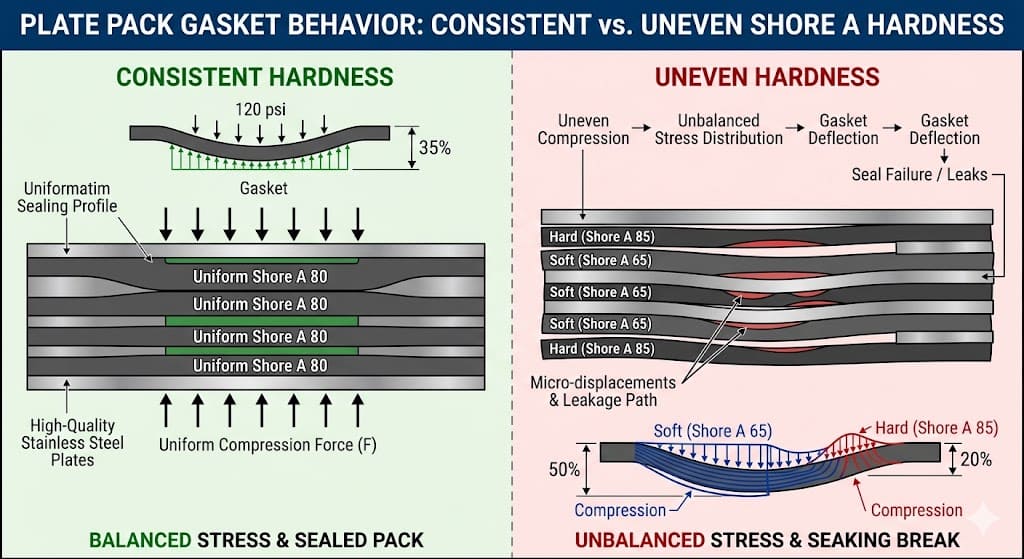
Let me tell you a story about a large district heating project. The project manager used low-quality aftermarket gaskets for a huge heat exchanger. After a few weeks of normal operation, the heat exchanger started leaking from the middle section. We went to the site. We took the large unit apart. We tested the rubber gaskets. Some gaskets were very hard. Some gaskets were very soft. They all came from the exact same cheap batch.
This is a very common failure when suppliers have poor quality control. Every rubber gasket has a Shore A Hardness rating. This rating measures how hard the rubber is. If the hardness changes from one gasket to the next, your plate pack will face serious problems. When you compress the heat exchanger, the physical force must spread evenly across all metal plates. But if one gasket is soft, it shrinks more under pressure. If the next gasket is hard, it resists the pressure. This creates an unbalanced load on the metal plates.
The metal plates start to shift slightly. We call this micro-displacement. It acts just like falling dominoes. One shifted plate pushes the next plate out of line. The whole plate pack becomes crooked. Soon, the entire seal breaks down and leaks begin. The heat exchanger loses its efficiency. At TIVO, we strictly control our rubber mixing process. We monitor our curing temperatures closely. We test the Shore A Hardness of every batch before shipment. We make sure every single gasket in your order has the exact same hardness. This uniform hardness guarantees a stable, straight, and leak-free plate pack for years. You do not have to worry about sudden middle-section leaks anymore.
| Hardness Condition | Plate Stress | Long-term Result |
|---|---|---|
| Inconsistent Hardness | Unbalanced | Micro-displacement and leaks |
| TIVO Consistent Hardness | Perfectly balanced | Stable operation |
Conclusion
You can avoid regasketing leaks by choosing spares with accurate pressing depths, exact geometries, and consistent hardness. TIVO guarantees these standards to keep your heat exchangers running safely.
Understanding Shore A hardness can help you choose the right gaskets for your applications. ↩
Learn about gasket cold flow to avoid costly leaks and ensure efficient operation. ↩
Understanding plate stress can help you maintain the integrity of your heat exchanger system. ↩
Understanding A-Measurement is crucial for effective gasket installation and preventing leaks. ↩
Understanding gasket thickness is key to preventing leaks and ensuring proper sealing. ↩
Explore how TIVO gaskets ensure precision and reliability, preventing leaks and costly downtime in your operations. ↩
Learn how pressing depth affects sealing pressure and overall gasket effectiveness. ↩
Discover how reverse-engineered molds enhance gasket performance and reliability. ↩
Explore how choosing the right gaskets can save you money on maintenance and downtime. ↩
Discover the impact of geometric interference on gasket sealing and how to prevent it. ↩
Learn about micro-displacements and their impact on gasket performance and leaks. ↩