Plant shutdowns cost money. You buy cheap replacement parts to save budget. But sudden leaks ruin your day. How do you find parts that actually work?
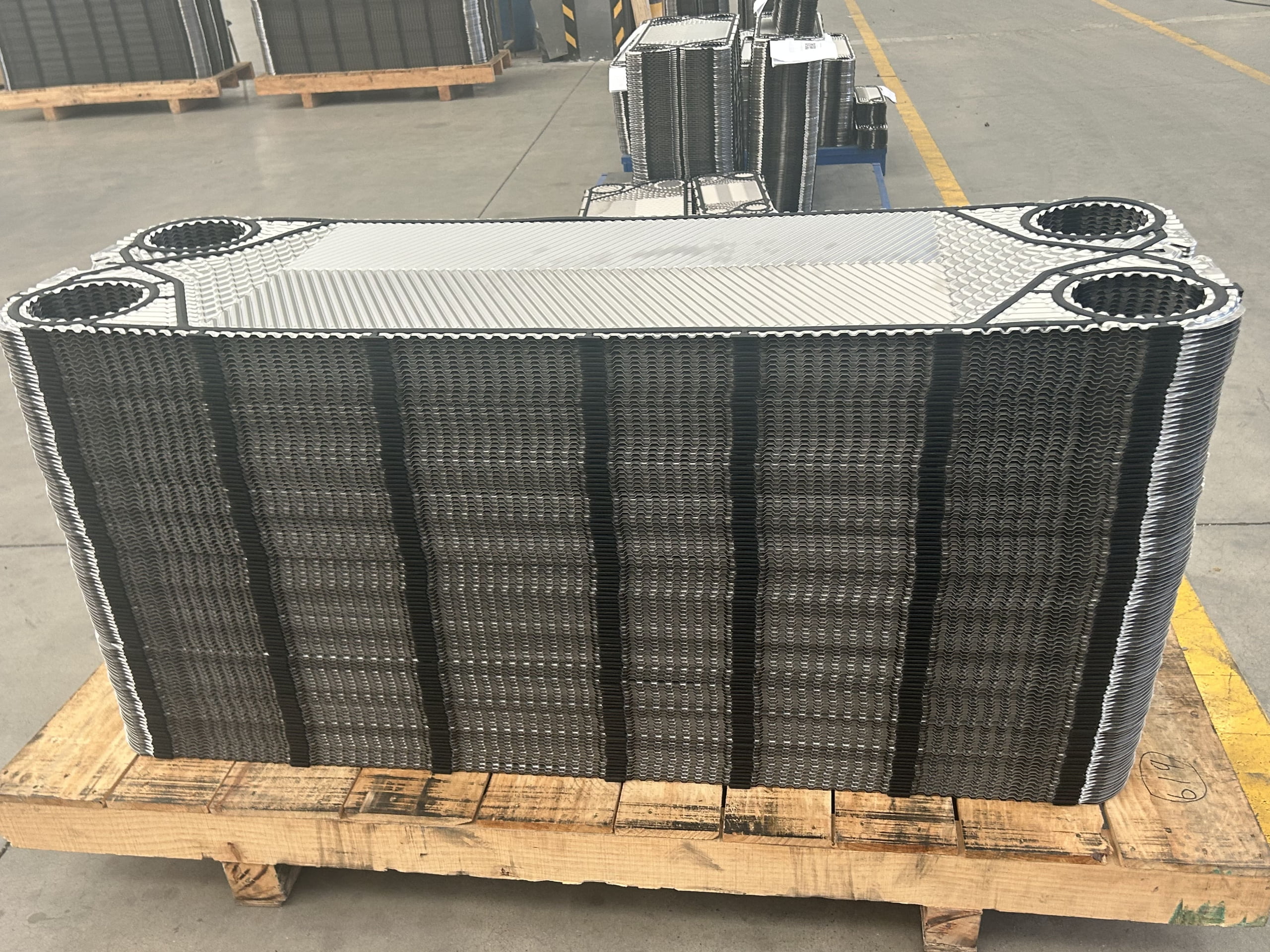
To source the best Alfa Laval M and TL series replacement parts1, you must match the exact plate corrugation2, verify the gasket prong tear strength3, and adjust the tightening dimension A based on plate thickness4. This ensures a perfect fit and stops dangerous leaks.
Do not stop reading here if you want to avoid costly maintenance failures. I will show you the exact technical details you need to check before you buy your next batch of spare parts.
What is the difference between Alfa Laval M Series and TL Series plates?
Wrong plate types cause poor heat transfer. You might buy the M series when you really need the TL series. This mistake drops your system efficiency fast.
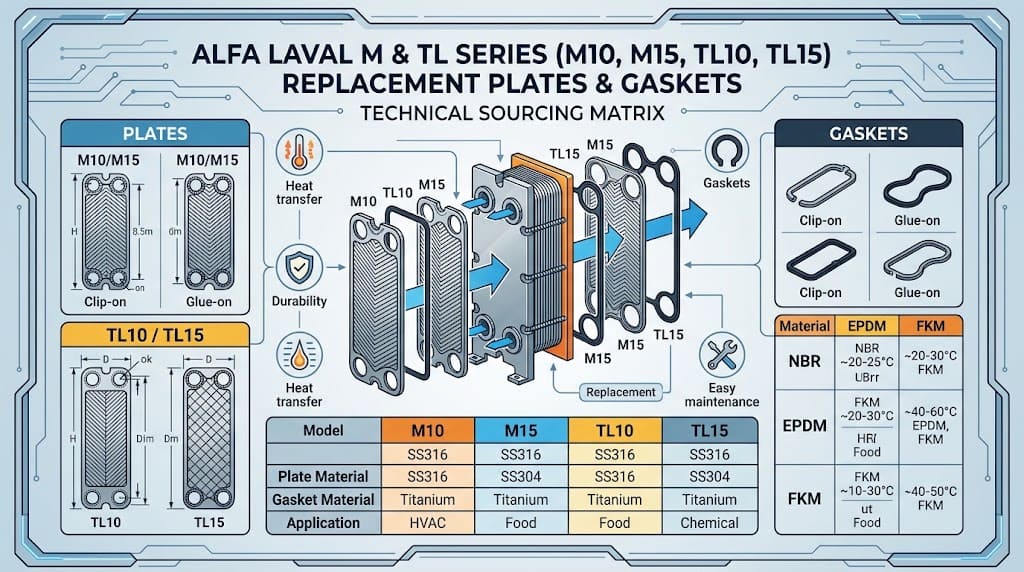
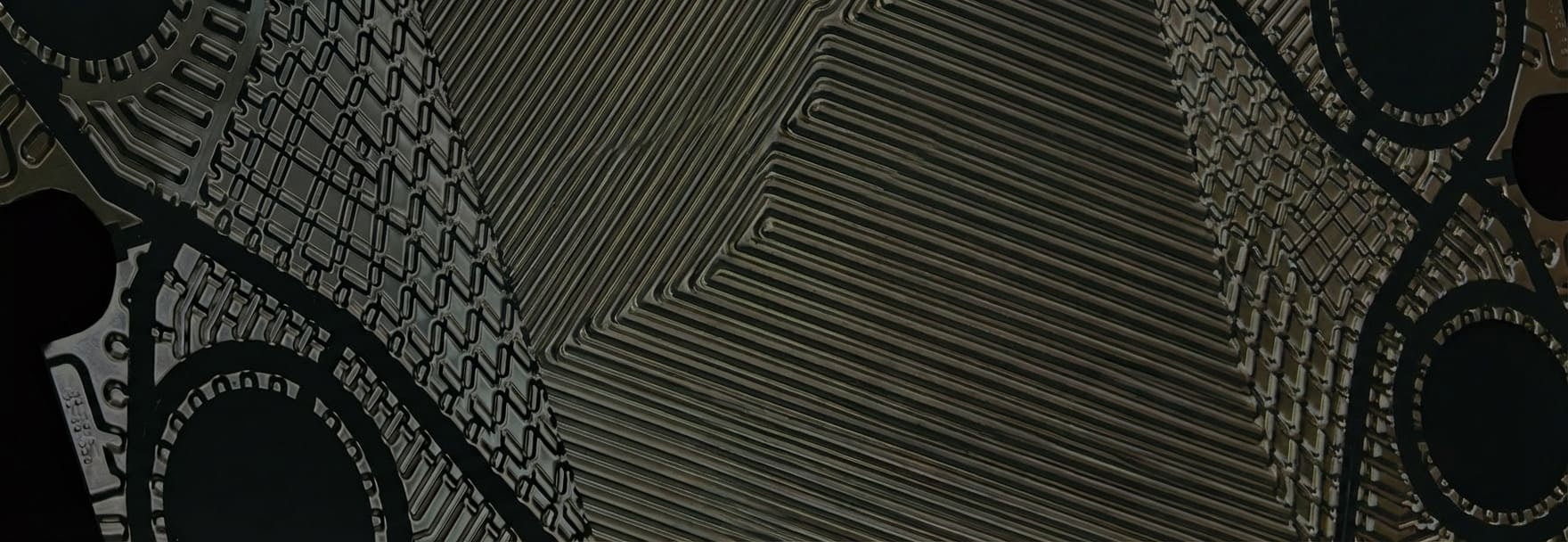
The M series uses a traditional V-shaped chevron pattern5 for uniform flow. The TL series uses an asymmetrical curve design at the port areas6. This special TL design stops stagnant zones and improves fluid distribution across the plate.
I remember a customer from Indonesia named Ahmad. He is 50 years old. He manages a big palm oil refinery. He bought replacement plates from a local supplier. He asked for M10 plates. The supplier gave him M10-M plates. But his old plates were actually TL10-B. He installed the new plates. His system lost heat transfer efficiency very fast. His pump had to work harder. He called me for help. I had to step in and explain the core differences between these two series. We at TIVO7 manufacture both types. We know exactly how they work in real plants.
M Series Corrugation Basics
The M series has a very standard design. It includes models like the M10-M and M15-M. It uses a Chevron pattern. You can also call it a V-shape or herringbone pattern. The fluid moves evenly across the whole width of the plate. You can choose different angles for these plates. The H angle is a large angle. It gives high heat transfer but also creates a high pressure drop. The L angle is a small angle. It gives low heat transfer and a low pressure drop. You must pick the right angle for your specific fluid.
TL Series Distribution Innovation
The TL series is different. It includes models like the TL10-B, TL10-P, and TL15-B. It has a special port area design. Alfa Laval calls this FlexFlow or CurveFlow. The port area has an asymmetrical pattern. This is very important for performance. It removes the dead corners where fluid does not move8. We call these stagnant zones. The fluid spreads out much better. This stops dirt from building up in the corners.
Quick Comparison Guide
| Feature | M Series (M10, M15) | TL Series (TL10, TL15) |
|---|---|---|
| Pattern Type | Traditional Chevron (V-shape) | Asymmetrical CurveFlow |
| Fluid Distribution | Uniform across the width | Optimized at port areas |
| Stagnant Zones | Normal amount | Greatly reduced |
| Angle Options | H angle and L angle | Specialized for high efficiency |
Why do cheap clip-on gaskets fail during installation?
You snap a new gasket onto a plate. The small rubber clip breaks off immediately. You waste time and money on cheap parts that do not fit.
Cheap clip-on gaskets fail because they lack reinforcing agents in the rubber9. This causes low tear strength. The rubber prongs break when stretched. If the prongs are too loose, the gasket slips. If they are too tight, the rubber cracks.
Many buyers look at the price first. This is a big mistake. The market has a huge price difference for third-party clip-on gaskets. I always tell my clients to look at the rubber quality. I visited a chemical plant in Saudi Arabia. The maintenance team used cheap gaskets to save money. The workers tried to install them. Half of the rubber clips broke right in their hands. They had to stop the plant for three more days. They lost a lot of money. The plant manager was very angry. He contacted us for better parts. We sent him our TIVO tested gaskets. They worked perfectly.
The Importance of Interference Fit
Alfa Laval M10, M15, and TL10 series mostly use a clip-gasket design. You do not use glue. The gasket locks into the edge of the plate. This relies on an interference fit. The rubber prongs, or clips, must fit perfectly into the holes on the plate edge. The size must be exact. If the mold is bad, the clip will not hold.
Rubber Strength and Vulcanization
A high-quality replacement gasket must have very high tear strength at the clip area. If the factory does not vulcanize the rubber evenly10, the gasket is weak. If the factory does not add reinforcing agents, the rubber is bad. When you pull the clip to attach it to the plate, a bad clip will break right away. You cannot use a broken gasket. It will leak.
The Danger of Bad Sizing
The size of the clip is also critical. If the clip is too loose, you have a big problem. When you push the plate pack together, the gasket will slip out of its groove. We call this slippage. If the clip is too tight, the rubber suffers. The tight clip creates local stress concentration. The rubber will crack very early. Your heat exchanger will leak after a few weeks.
| Gasket Quality | Clip Fit | Result During Installation |
|---|---|---|
| Low Quality | Too Loose | Gasket slips out of the groove |
| Low Quality | Too Tight | Rubber cracks from stress |
| Low Quality | Weak Rubber | Prongs break when stretched |
| High Quality | Perfect Fit | Secure lock, no leaks |
How does plate thickness affect the tightening dimension A?
You change the plates inside your heat exchanger. You close the unit. You turn on the pump. A huge leak sprays everywhere. You used the wrong tightening dimension.
Changing plate thickness from 0.6mm to 0.5mm changes your tightening dimension A. For every 100 plates, the total length drops by 10mm. You must calculate the new dimension. Using the old nameplate dimension causes low gasket compression and massive leaks.
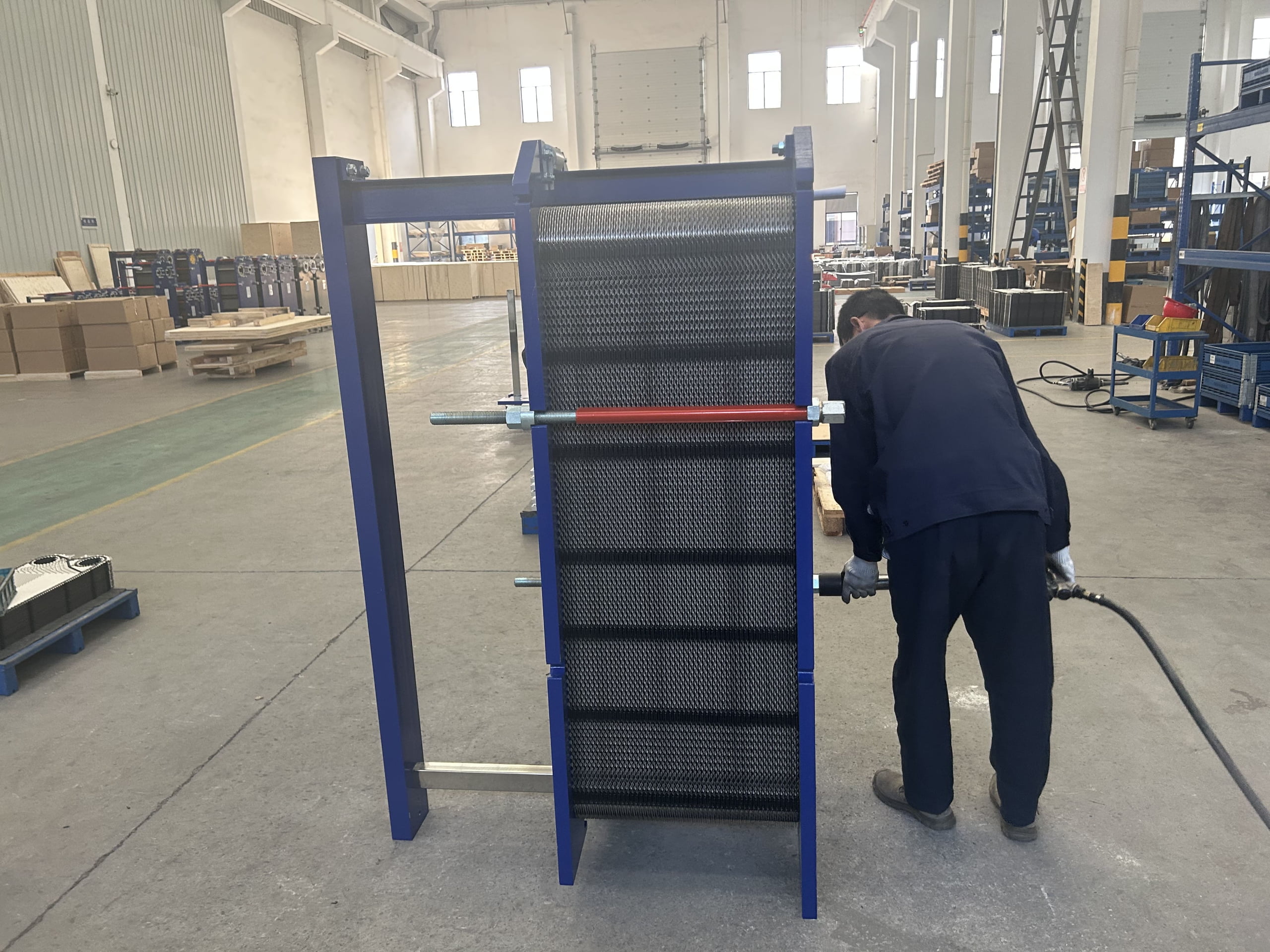
This is the most common mistake I see in the field. People forget that plates come in different thicknesses. A project manager in Turkey named Sergey called me once. He works for a big EPC company. His team installed 300 new plates. They closed the unit. They turned on the water pump to test the pressure. The heat exchanger leaked everywhere. Water sprayed all over the floor. I asked him about the new plate thickness. He did not know it mattered. He bought 0.5mm plates to save cost. But his old plates were 0.6mm. He used the old tightening rule. I had to teach him how to fix it.
The Chain Reaction of Thickness
You have two common plate thicknesses in the market. You can buy 0.5mm plates. You can buy 0.6mm plates. This small difference creates a big chain reaction. Let us look at a heat exchanger with 100 plates. If you change the plates from 0.6mm to 0.5mm, you lose 0.1mm per plate. For 100 plates, you lose 10mm in total. This means your whole plate pack is now 10mm shorter.
The Danger of the Nameplate
Every heat exchanger has a nameplate. The nameplate shows the original Dimension A. Dimension A is the exact tightening length for the tie rods. Maintenance workers often just look at the nameplate. They tighten the rods to the old Dimension A. But the new plates are thinner. The old Dimension A is now too big for the new plates.
Gasket Compression Failure
If you tighten the new, thinner plates to the old dimension, you have a disaster. The gasket does not get enough pressure. The compression rate will be less than 15 percent11. This is not enough to seal the fluids. When you do the pressure test, the unit will definitely leak. You must always calculate the new Dimension A based on the exact plate thickness12 you buy.
| Plate Thickness | Number of Plates | Total Pack Reduction | Action Required |
|---|---|---|---|
| 0.6mm (Original) | 100 | 0mm | Use original Dimension A |
| 0.5mm (New) | 100 | 10mm | Calculate new Dimension A |
| 0.5mm (New) | 300 | 30mm | Calculate new Dimension A |
Conclusion
Always check plate patterns, test gasket clip strength, and calculate the correct tightening dimension. These simple steps stop leaks and keep your heat exchangers running safely and efficiently.
"Features that set new standards", https://www.alfalaval.us/products/heat-transfer/plate-heat-exchangers/gasketed-plate-and-frame-heat-exchangers/unique-features/. The source provides detailed technical specifications and guidelines for selecting and maintaining Alfa Laval M and TL series replacement parts, emphasizing the importance of matching plate corrugation, gasket quality, and tightening dimensions to prevent leaks and ensure optimal performance. Evidence role: general_support; source type: education. Supports: To source the best Alfa Laval M and TL series replacement parts, you must match the exact plate corrugation, verify the gasket prong tear strength, and adjust the tightening dimension A based on plate thickness.. ↩
"Troubleshooting for plate heat exchangers | Alfa Laval", https://www.alfalaval.com/service-and-support/product-services/plate-heat-exchanger-services/troubleshooting-for-plate-heat-exchangers/. This source explains the importance of matching plate corrugation patterns to ensure optimal heat transfer and system efficiency. Evidence role: mechanism; source type: education. Supports: Matching the exact plate corrugation ensures a perfect fit and stops dangerous leaks.. ↩
"Sealing success: a comprehensive guide to plate heat exchanger gaskets", https://heat-exchanger-world.com/sealing-success-a-comprehensive-guide-to-plate-heat-exchanger-gaskets/. This source discusses the role of gasket tear strength in preventing installation failures and ensuring secure sealing. Evidence role: mechanism; source type: research. Supports: Verifying gasket prong tear strength is essential to prevent leaks and ensure proper installation.. ↩
"Plate heat exchanger calculation method - Alfa Laval", https://www.alfalaval.com/microsites/gphe/tools/calculation-method/. This source explains how plate thickness affects tightening dimensions and the consequences of incorrect adjustments. Evidence role: mechanism; source type: education. Supports: Adjusting the tightening dimension A based on plate thickness prevents leaks caused by improper gasket compression.. ↩
"Plate heat exchanger - Wikipedia", https://en.wikipedia.org/wiki/Plate_heat_exchanger. This source provides an overview of the chevron pattern used in M series plates and its impact on fluid flow. Evidence role: definition; source type: encyclopedia. Supports: The M series uses a traditional V-shaped chevron pattern for uniform flow.. ↩
"Symmetric versus asymmetric tibial components: A systematic review of ...", https://pmc.ncbi.nlm.nih.gov/articles/PMC11562716/. This source explains the asymmetrical curve design in TL series plates and its role in reducing stagnant zones. Evidence role: mechanism; source type: research. Supports: The TL series uses an asymmetrical curve design at the port areas to improve fluid distribution.. ↩
"Ultimate Guide: High-Performance APV Titanium Plates & Gaskets ...", https://tivo-heatexchanger.com/apv-titanium-plate-heat-exchanger-replacement-parts-matrix/. TIVO is a manufacturer of heat exchanger replacement parts, including plates and gaskets, as mentioned in the article. Evidence role: general_support; source type: other. Supports: TIVO manufactures both M series and TL series replacement plates for Alfa Laval heat exchangers.. Scope note: The source does not provide independent verification of TIVO's manufacturing capabilities. ↩
"Impact of a Plate on an Asymmetric Water Wedge | J. Fluids Eng.", https://asmedigitalcollection.asme.org/fluidsengineering/article-abstract/142/4/041301/1066079/Impact-of-a-Plate-on-an-Asymmetric-Water-Wedge. This source discusses how asymmetrical designs in heat exchanger plates eliminate stagnant zones and improve efficiency. Evidence role: mechanism; source type: research. Supports: The TL series design removes dead corners where fluid does not move, improving efficiency.. ↩
"Nitrile Rubber Gasket Material: Comprehensive Analysis Of ...", https://eureka.patsnap.com/materials/nitrile-rubber-gasket. This source explains the role of reinforcing agents in rubber gaskets and their impact on tear strength. Evidence role: mechanism; source type: research. Supports: Reinforcing agents in the rubber improve tear strength and prevent gasket prong failure.. ↩
"Vulcanization - Wikipedia", https://en.wikipedia.org/wiki/Vulcanization. This source explains the vulcanization process and its impact on rubber gasket durability. Evidence role: mechanism; source type: research. Supports: Even vulcanization of rubber improves gasket durability and prevents early failure.. ↩
"Gasket Compression Explained | Rubber Gaskets - Elasto Proxy", https://www.elastoproxy.com/enclosure-gasket-compression/. This source discusses the relationship between gasket compression rates and sealing effectiveness in heat exchangers. Evidence role: mechanism; source type: research. Supports: A compression rate less than 15 percent leads to insufficient sealing and leaks in heat exchangers.. ↩
"[PDF] Impact of Plate Thickness and Joint Geometry on Residual Stresses in ...", https://www.osti.gov/servlets/purl/2205663. This source explains how to calculate Dimension A based on plate thickness changes in heat exchangers. Evidence role: mechanism; source type: education. Supports: Calculating the new Dimension A based on plate thickness prevents leaks caused by improper tightening.. ↩