Are your heat exchanger gaskets1 failing too soon? Oil leaks cause very costly downtime. You need the right gasket material to stop these sudden leaks for good.
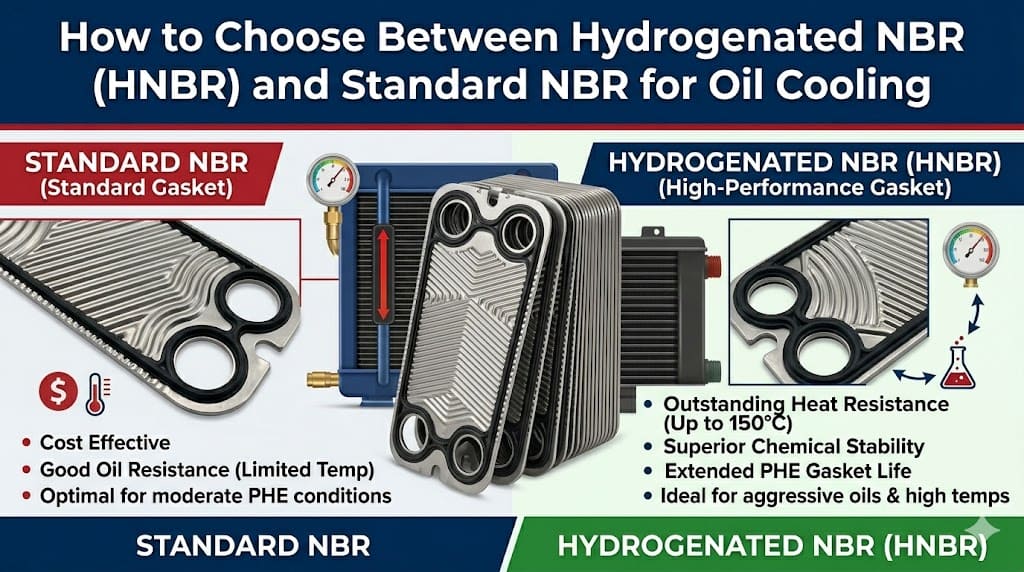
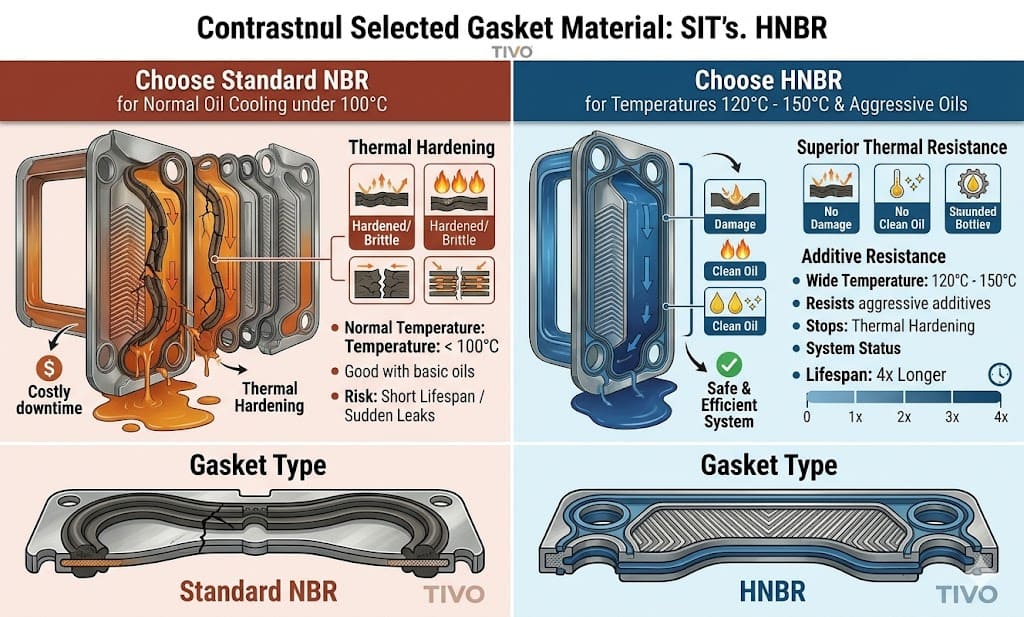
Choose Standard NBR2 for normal oil cooling under 100°C. Choose Hydrogenated NBR (HNBR)3 for temperatures between 120°C and 150°C, or when oils have aggressive additives. HNBR stops thermal hardening4 and lasts four times longer. This choice keeps your system safe.
I see many clients struggle with sudden oil leaks. They think their gaskets have bad quality. But often, they just use the wrong rubber for their specific oil. Stop losing money on quick fixes. Let us look at why the right material matters so much. If you choose the wrong rubber, you will face more leaks very soon.
What makes HNBR different from standard NBR chemically?
Heat destroys normal rubber. Hard gaskets crack and leak when you cool them down. You must know the chemical difference5 to protect your heat exchangers.
HNBR goes through a special hydrogenation process. This process removes unstable double bonds in the rubber. Because of this, HNBR keeps its high elasticity even when oil temperatures change from 120°C to 150°C. It does not become hard like standard NBR.
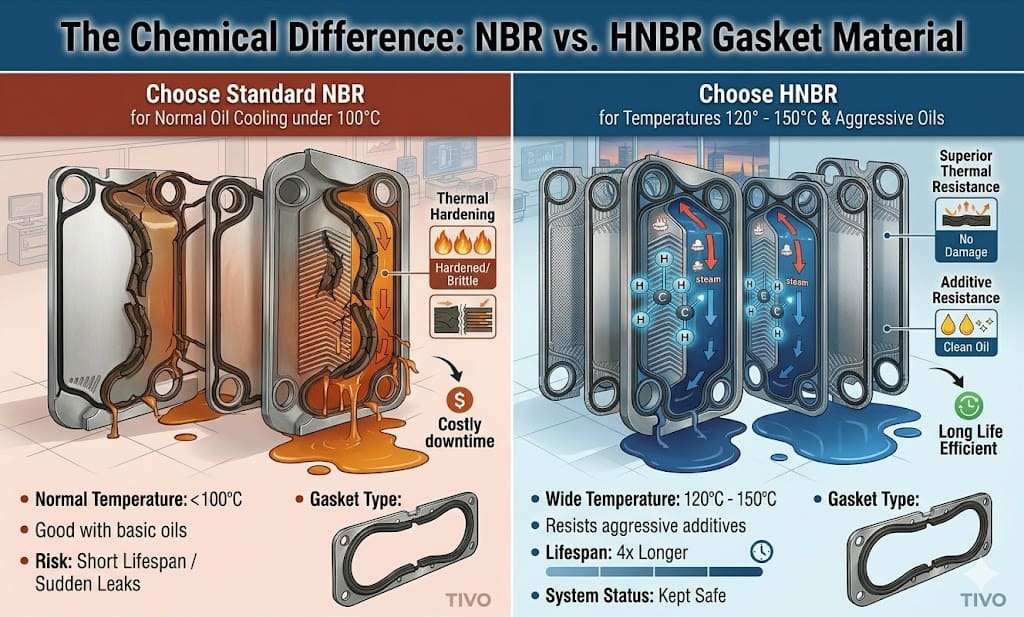
Standard NBR has many unstable double bonds in its chemical structure. Heat and oxygen attack these bonds easily. When this happens, the rubber loses its flexibility. We call this "thermal hardening". I remember a client who used standard NBR for a hot oil cooler. His system ran at 130°C. The gaskets became as hard as plastic in just a few months. When he stopped the machine for a weekend, the metal plates cooled down and shrank. The hard gaskets could not expand to fill the gaps. When he restarted the machine on Monday, oil sprayed everywhere. We call this a "cold leak6". HNBR solves this problem completely. The hydrogenation process removes those weak double bonds. The rubber stays soft and bouncy, even when oil temperatures jump up and down between 120°C and 150°C. When your machine stops and cools down, the HNBR gasket still pushes hard against the metal plates. You will not see any cold leaks when you restart your system. This simple chemical change makes a huge difference for your factory.
How do oil additives7 attack standard NBR gaskets?
Modern oils have strong chemicals inside. These chemicals eat standard rubber fast. You need a better material to stop this hidden damage to your gaskets.
Modern industrial oils use anti-wear additives like ZDDP. High heat makes these additives release active sulfur and phosphorus. These elements attack the cross-links in standard NBR. HNBR has a natural resistance to these polar additives. It will not crack or break down in these modern oils.
Many clients call me with a strange problem. Their original NBR gaskets show deep cracks on the surface after only five or six months. They always think the gasket quality is very bad. I always tell them that this is not a quality issue. This is a chemical compatibility issue. Modern industrial oils8 are very complex. Oil makers add special anti-wear chemicals to protect metal gears. A common additive is ZDDP. When the oil gets hot, these additives break down. They release active sulfur and phosphorus into the oil. These strong elements attack the weak points in standard NBR rubber. They break the chemical cross-links that hold the rubber together. The surface of the gasket becomes dry and cracks open. Upgrading to HNBR is the only logical choice here. HNBR naturally resists these polar additives. The sulfur and phosphorus cannot break its strong chemical bonds. If you use modern lubricating oils or hydraulic fluids, you must check the additive list. If you see anti-wear chemicals, standard NBR will fail quickly. You must use HNBR to keep your plates sealed tight.
Can HNBR handle pressure pulsations9 better than standard NBR?
Oil pumps create strong pressure waves. These waves push and pull your gaskets constantly. You need a tough material to survive this heavy mechanical stress.
Yes, HNBR handles pressure pulsations much better. Oil cooling systems often have strong pressure spikes. HNBR has two to three times more tear strength10 and wear resistance11 than standard NBR. It holds its shape better and keeps a strong seal under heavy pressure.
Oil cooling systems never have a steady pressure. The oil pumps create constant pressure pulsations. The pressure goes up and down very fast. This movement pushes the rubber gaskets out of their grooves. The metal plates also squeeze the gaskets very hard. Over time, standard NBR suffers from "cold flow" deformation. The rubber flattens out and cannot bounce back. It loses its sealing edge. HNBR is much stronger mechanically. Its tear strength is two to three times higher than standard NBR. Its wear resistance is also much better. When the metal plates squeeze an HNBR gasket, the sealing edge stays sharp and strong. It does not flatten out easily. It maintains the right sealing pressure for a very long time. I helped a large heat pump manufacturer last year. Their oil coolers leaked because of heavy vibrations and pressure spikes. We changed their standard NBR gaskets to HNBR. The leaks stopped immediately. The HNBR absorbed the pressure waves without losing its shape. Stronger rubber means a safer heat exchanger for your high-pressure systems.
Is the higher cost of HNBR really worth it for your plant?
HNBR costs more money up front. Factory managers often hate spending extra money. You must look at the total cost to make the right choice.
Yes, HNBR is absolutely worth the higher price. In critical industrial processes, an unexpected machine shutdown12 costs much more than new gaskets. Experience shows that HNBR lasts four times longer than standard NBR in hot oil conditions. You save money on labor and lost production.
The purchase price of HNBR is significantly higher than standard NBR. This price tag scares many procurement managers. They want to buy the cheaper standard NBR to save money today. But I always ask them to look at the big picture. You must calculate the true cost of a sudden oil leak. If a standard NBR gasket fails, your whole production line stops. You lose thousands of dollars every hour. You also have to pay maintenance workers to open the heat exchanger and clean up the spilled oil. The cost of one unexpected shutdown is far greater than the price difference between the two gasket materials. We have collected a lot of data from our clients over the years. In high-temperature oil cooling13 jobs, the replacement cycle for HNBR is usually four times longer than standard NBR. If you change standard NBR every six months, you will only change HNBR every two years. You buy fewer spare parts over time. You also reduce your maintenance labor costs. Upgrading to HNBR is a smart investment that protects your factory from expensive downtime.
Conclusion
Choose standard NBR for simple, cool jobs. Upgrade to HNBR for high temperatures, modern oil additives, and heavy pressure. This smart choice stops leaks and saves your factory money.
Explore this resource to understand the best materials for heat exchanger gaskets, ensuring durability and preventing costly leaks. ↩
Explore how Standard NBR is suitable for normal oil cooling applications and its limitations. ↩
Learn about the advantages of HNBR, especially in high-temperature and aggressive environments. ↩
Understand the phenomenon of thermal hardening and its impact on gasket performance. ↩
Discover the chemical properties that make HNBR superior to standard NBR. ↩
Learn about cold leaks, their causes, and how to prevent them in your systems. ↩
Understand how oil additives can damage gaskets and the need for compatible materials. ↩
Explore the complexities of modern industrial oils and their impact on gasket materials. ↩
Find out how pressure pulsations can lead to gasket failure and how to mitigate this. ↩
Learn about tear strength and why it's crucial for gaskets in high-pressure systems. ↩
Explore the importance of wear resistance in extending the life of gaskets. ↩
Understand the financial implications of machine shutdowns due to gasket failures. ↩
Discover the specific challenges faced in high-temperature oil cooling and solutions. ↩