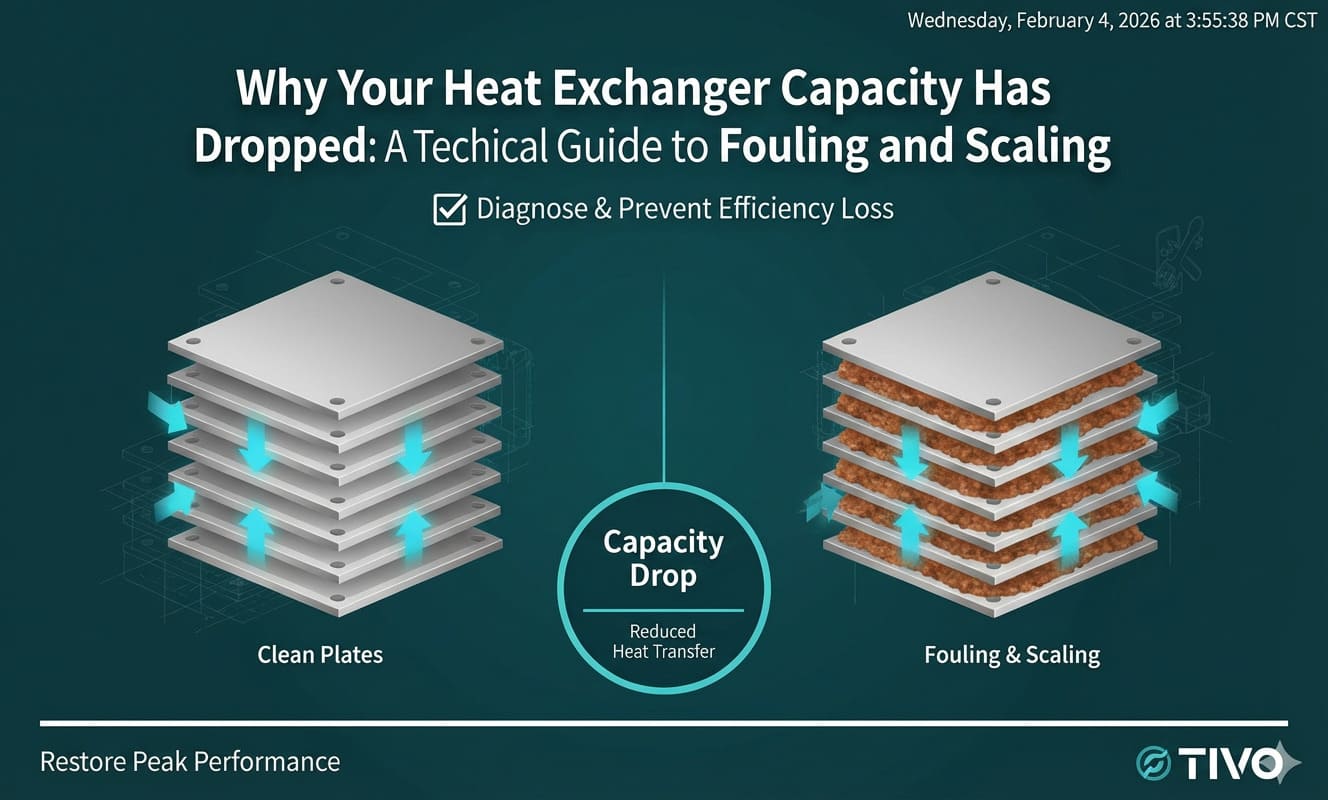
Why Your Heat Exchanger Capacity Has Dropped: A Technical Guide to Fouling and Scaling
In my 15 years of troubleshooting thermal systems, the most common call I get starts with: "Evan, our approach temperature is widening, and we just aren't hitting our numbers anymore." When your heat exchanger capacity drops, you aren't just losing heat—you are burning money in extra pumping power and wasted fuel.
Usually, the culprits are two silent efficiency killers: Fouling and Scaling. While they sound similar, treating them the same way is a mistake that leads to recurring downtime.
1. Scaling vs. Fouling: The Diagnostic Matrix
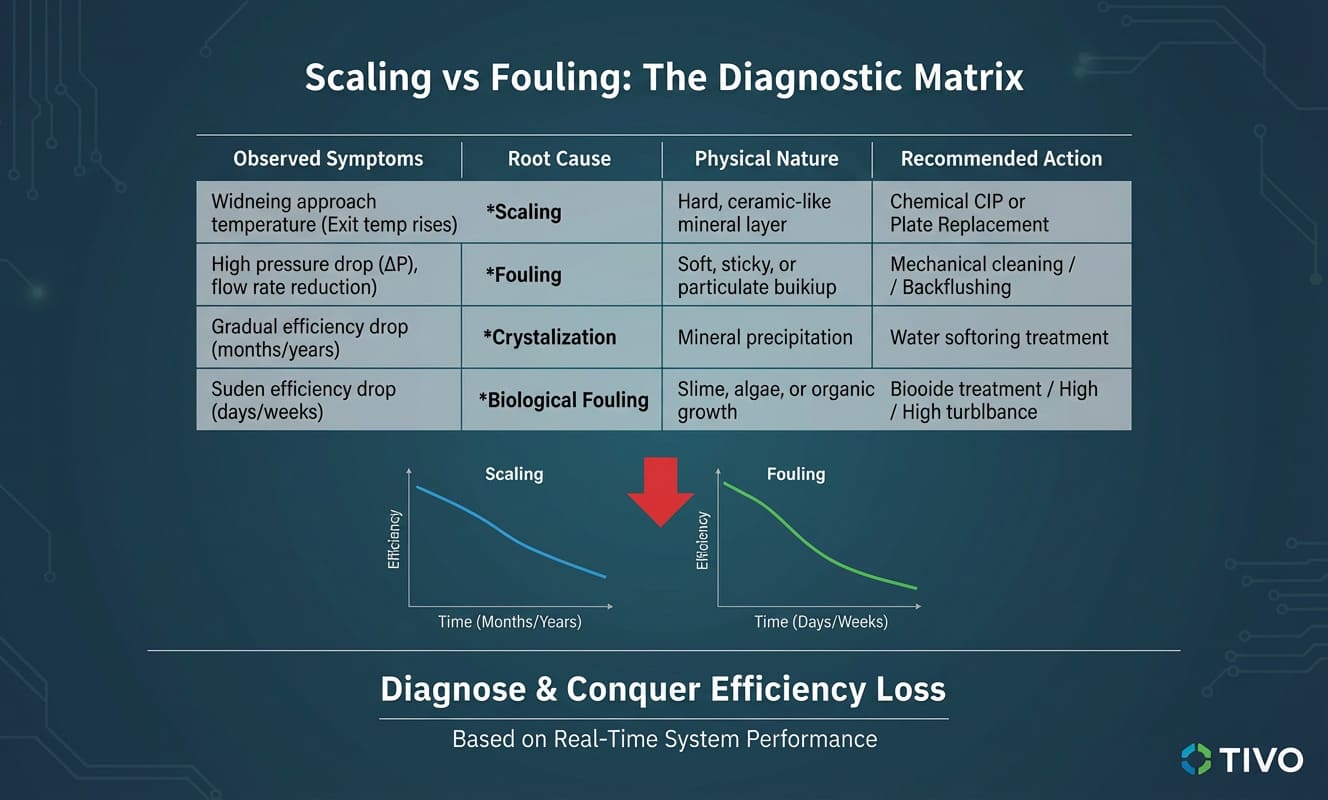
To fix the problem, you must first identify the enemy. I have developed this matrix to help my clients diagnose their units based on real-time symptoms:
| Observed Symptoms | Root Cause | Physical Nature | Recommended Action |
|---|---|---|---|
| Widening approach temperature (Exit temp rises) | Scaling | Hard, ceramic-like mineral layer | Chemical CIP or Plate Replacement |
| High pressure drop (ΔP), flow rate reduction | Fouling | Soft, sticky, or particulate buildup | Mechanical cleaning / Backflushing |
| Gradual efficiency drop (months/years) | Crystallization | Mineral precipitation | Water softening treatment |
| Sudden efficiency drop (days/weeks) | Biological Fouling | Slime, algae, or organic growth | Biocide treatment / High turbulence |
2. Scaling: The "Hard" Enemy
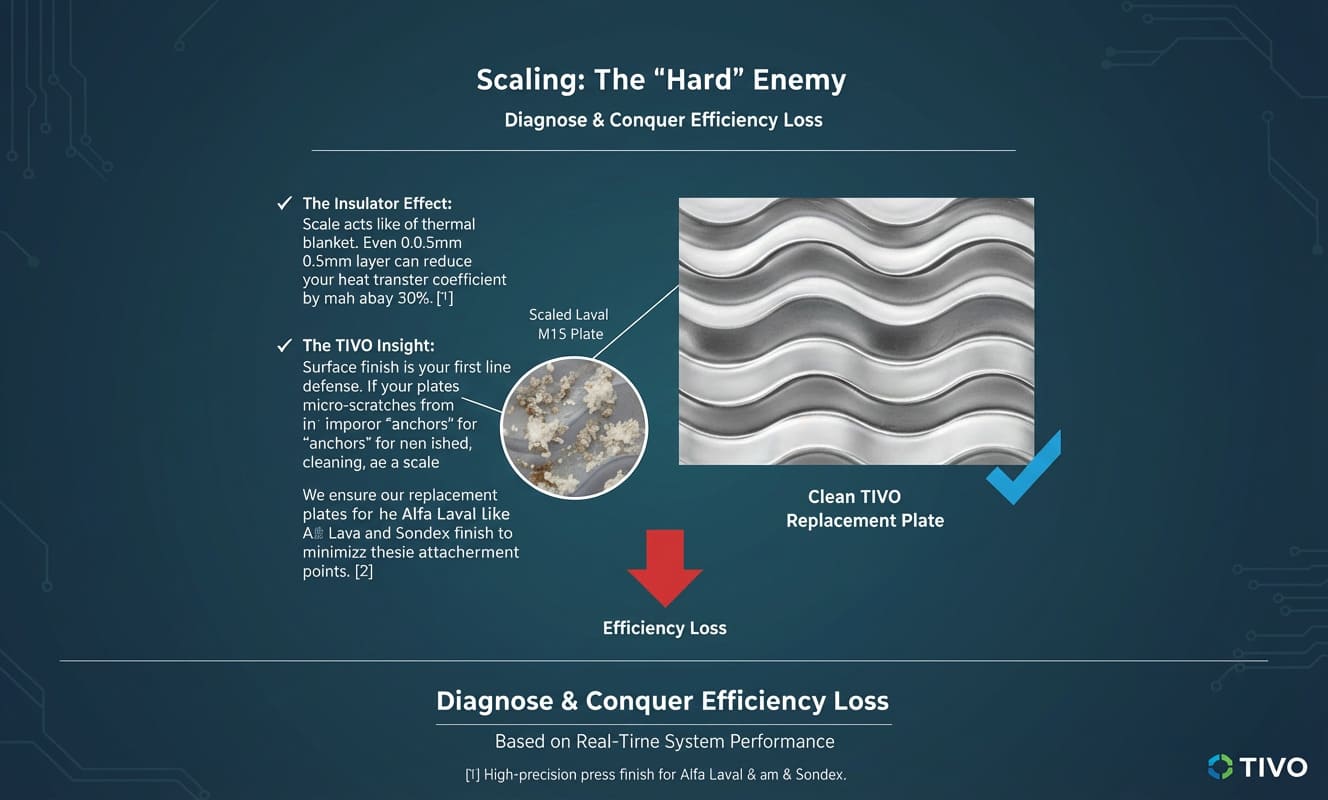
Scaling occurs when minerals—usually calcium carbonate—precipitate out of the fluid and bake onto the hot metal surface.
- The Insulator Effect: Scale acts like a thermal blanket. Even a 0.5mm layer can reduce your heat transfer coefficient by as much as 30%. 1
- The TIVO Insight: Surface finish is your first line of defense. If your plates have micro-scratches from improper cleaning, you’ve created "anchors" for scale. We ensure our replacement plates for brands like Alfa Laval and Sondex have a high-precision press finish to minimize these attachment points. 2
3. Fouling: The "Sticky" Obstacle
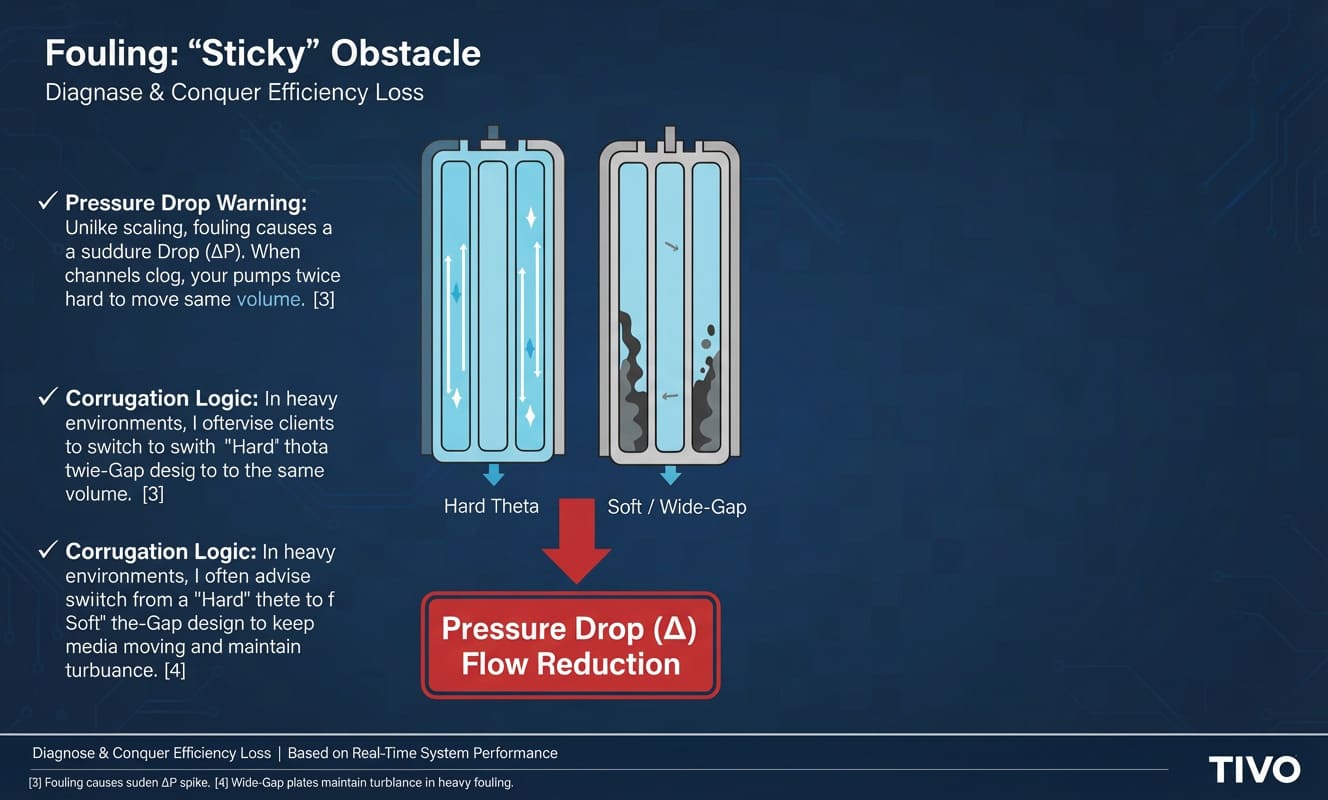
Fouling is the physical accumulation of "stuff" in the channels. It could be silt, sand, or carbonized oil in high-temperature applications.
- Pressure Drop Warning: Unlike scaling, fouling causes a sudden spike in Pressure Drop (ΔP). When channels clog, your pumps work twice as hard to move the same volume. 3
- Corrugation Logic: In heavy fouling environments, I often advise clients to switch from a "Hard" theta plate to a "Soft" theta or Wide-Gap design to keep the media moving and maintain turbulence. 4
4. The Economic Impact of Neglect
Many managers wait for a total failure before acting. Here is why that strategy is the most expensive one:
| Operation Status | U-Value | Energy Waste | Unplanned Downtime Risk | Suggested Strategy |
|---|---|---|---|---|
| Clean State | 100% | 0% | Extremely Low | Regular ΔP Monitoring |
| Light Scale (0.1mm) | ~85% | +10% | Low | Schedule Off-peak CIP |
| Severe Scale (0.5mm) | ~60% | +35% or more | High (Clogging) | Replace with TIVO 1:1 Plates |
| Corrosive Fouling | <50% | Double Costs | Total Asset Loss | Upgrade to Viton/Titanium |
5. Breaking the "Fouling-Corrosion Loop"
In aggressive media like Amine cycles, the wrong material accelerates fouling. 5 When a plate corrodes, it becomes porous, trapping more debris. This is why I insist on Viton G-series gaskets and high-purity Titanium for high-stakes loops. By preventing initial corrosion, we stop the fouling cycle before it starts. 6
My Final Advice
Efficiency isn't a "set and forget" metric. If you notice your capacity dropping, don't just increase pump speed—look at the plates. Whether it's a Hisaka UX-series or an APV Paraflow, understanding the chemistry of your fouling is the only way to choose the right replacement strategy. 7
🚀 Stop Wasting Energy: Get Your Technical Assessment Today
Is your heat exchanger underperforming? Don't wait for a total system blowout. Send us your current operating temperatures and pressure drop readings, and my engineering team will provide a Free Fouling Analysis and a 1:1 replacement quote within 24 hours.
[Get a Quote & Lead Time for Replacement Plates] (Hyperlink to your Contact/RFQ page)
🔗 Footnotes & Technical References (Internal Links)
Technical analysis of [thermal resistance and scale thickness](https://tivo-heatexchanger.com/gphe/) in industrial cooling loops. ↩
Detailed guide on [plate surface finish and fouling resistance](https://tivo-heatexchanger.com/searching-for-alfa-laval-m15-mfg-gaskets-a-technical-comparison-of-oem-vs-tivo-quality/). ↩
Understanding [Pressure Drop (ΔP) as a diagnostic tool](https://tivo-heatexchanger.com/replacement-apv-paraflow-plate-heat-exchanger-plates-gaskets/) for industrial units. ↩
My strategic guide on [choosing the right plate corrugation](https://tivo-heatexchanger.com/gphe/) for high-debris environments. ↩
Professional comparison: [Viton vs. EPDM](https://tivo-heatexchanger.com/plate-heat-exchanger-gasket-material-guide-when-to-choose-viton-over-epdm/) in chemical and Amine service. ↩
Learn how [Material Selection affects fouling rates](https://tivo-heatexchanger.com/gea-vt-series-replacement-plates-gaskets-the-complete-technical-guide-for-model-matching-maintenance-reliability/) in corrosive applications. ↩
Learn how [press depth and A-dimension](https://tivo-heatexchanger.com/searching-for-alfa-laval-m15-mfg-gaskets-a-technical-comparison-of-oem-vs-tivo-quality/) calculations restore flow geometry. ↩