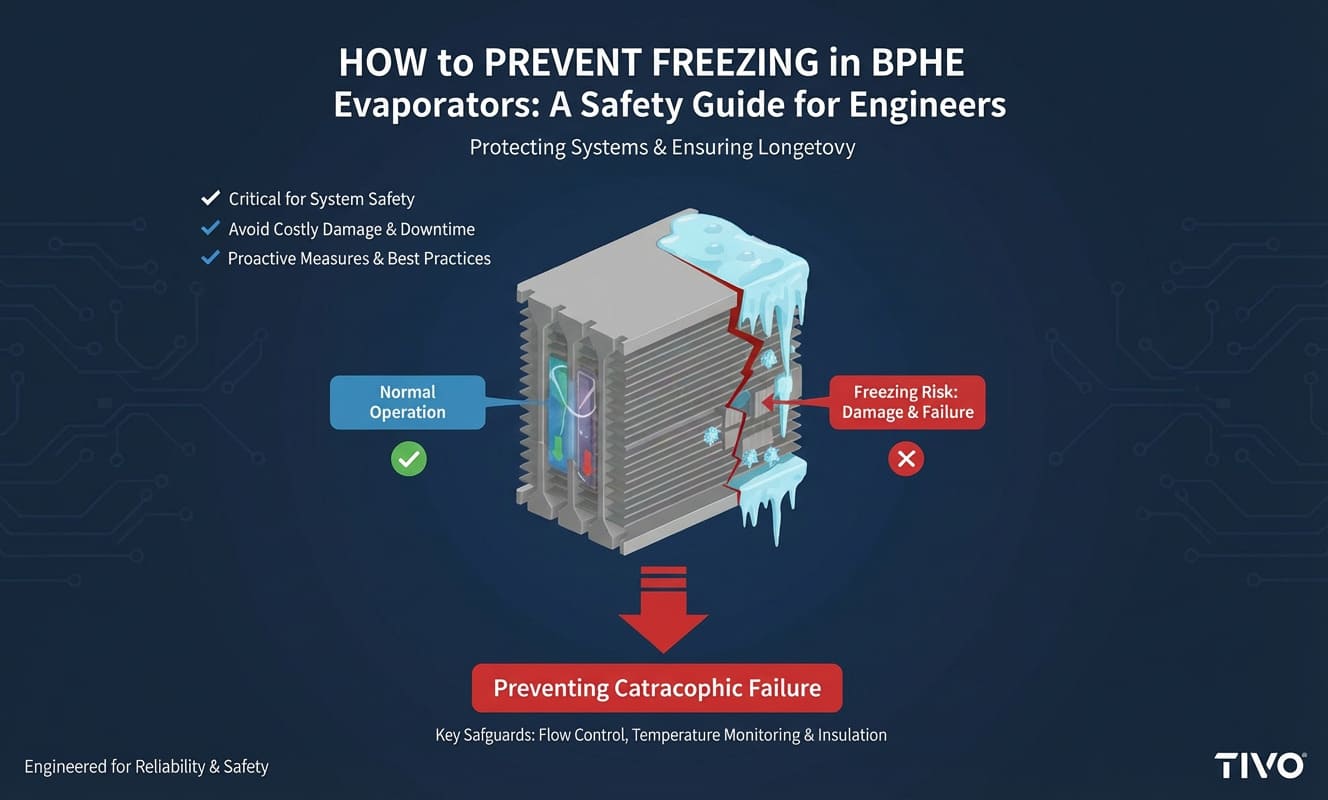
Are your brazed plate heat exchangers1 cracking from ice? Freeze-ups cause major downtime and cost you money. I will show you how to stop this problem forever.
To prevent BPHE evaporator freeze-ups, you must use internal refrigerant distributors2 for even flow, install differential pressure switches3 alongside flow switches, monitor the saturation evaporation temperature4, and implement a pump-down cycle5. These steps stop ice formation6 before it cracks your plates.
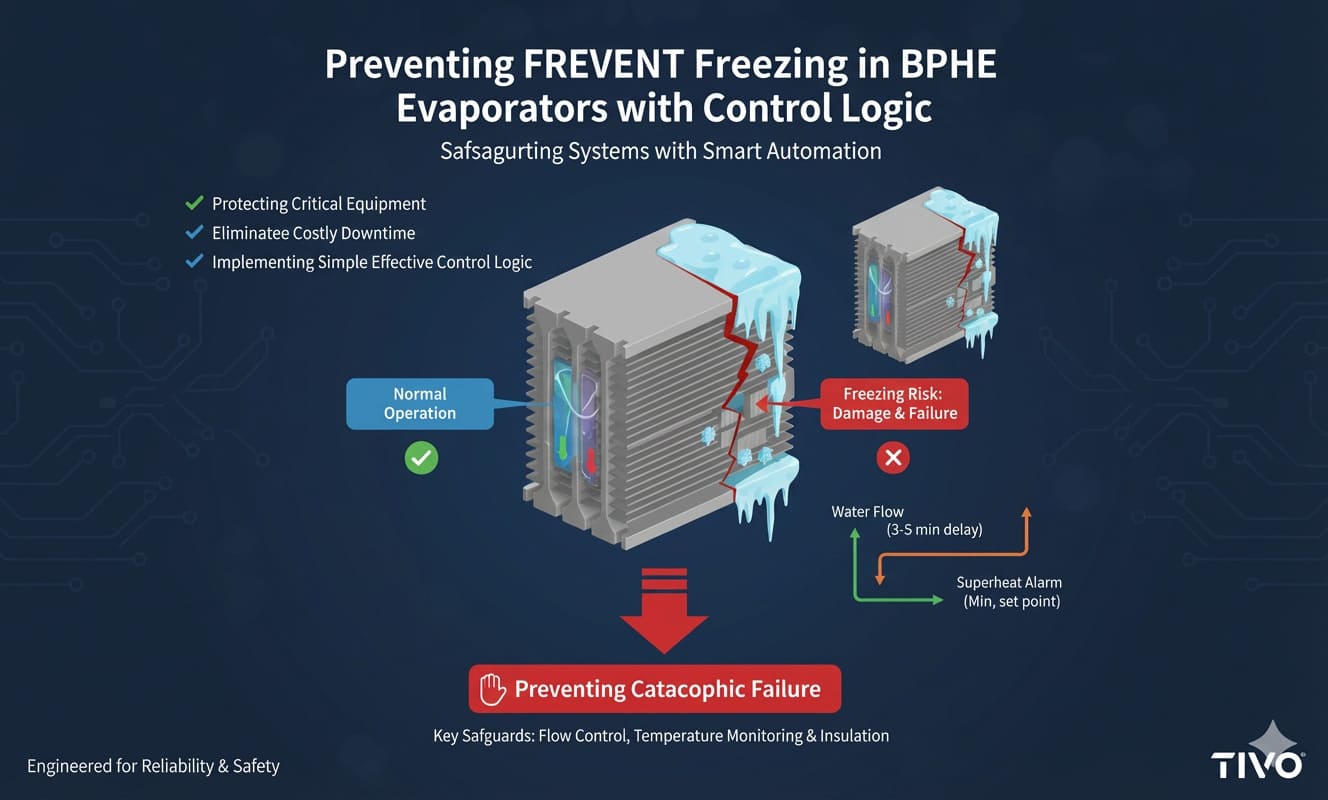
Many engineers think a simple water temperature sensor keeps their chillers safe. I used to believe this too. Then a sudden freeze-up destroyed a brand new system on my site. The water temperature looked fine on the screen. But the inside of the heat exchanger was full of ice. This disaster forced me to study the real causes of these failures. Let me explain the real reasons behind these failures and how you can protect your equipment.
Why Does Local Freezing Hide Inside Your BPHE Evaporator?
Water temperature looks normal, but your system still freezes? Hidden ice builds up inside single channels. This silent threat can burst your heat exchanger without any warning.
Local freezing happens when refrigerant distribution is uneven. Some channels get too cold and freeze, even if the overall water temperature is safe. Using a BPHE with a built-in distributor ensures equal refrigerant flow7 and stops local ice formation.
The Danger of Uneven Flow
I see this problem often in standard heat exchangers. The refrigerant enters the inlet port. It wants to take the easiest path. This leaves some channels with too much refrigerant. Other channels get too little. The channels with too much refrigerant get very cold. The water in these specific channels starts to freeze. You cannot see this from the outside. The main water sensor mixes the water from all channels. The sensor reads a safe temperature. But ice is already growing inside.
How Distributors Fix the Problem
At TIVO, we put a special distributor inside our BPHE units. This device acts like a traffic cop. It forces the liquid refrigerant and the gas to mix perfectly. It pushes the exact same amount of refrigerant into every single channel.
Why You Need Equal Distribution
When the flow is equal, the temperature is equal. No single channel drops below the freezing point faster than the others. This is your first line of defense against ice.
| Problem | Cause | Solution |
|---|---|---|
| Local Freezing | Uneven refrigerant flow in channels | Use a BPHE with an internal distributor |
| False Safe Readings | Water mixes at the outlet | Monitor individual channel design8 |
| Plate Cracking | Ice expands inside a single channel | Ensure equal pressure and flow across plates |
Can You Trust Your Mechanical Flow Switch During a Freeze?
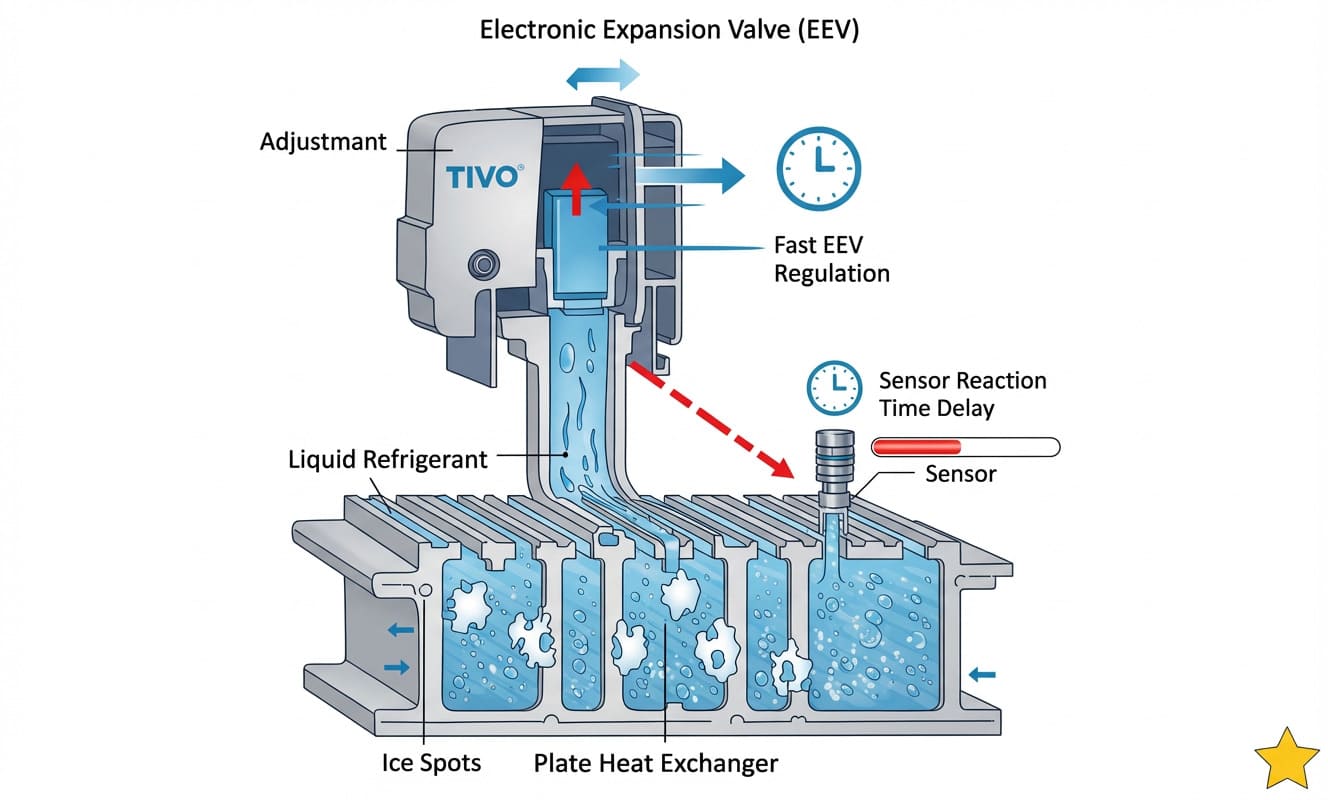
Mechanical flow switches react slowly. When ice starts forming, every second counts. A slow response means your BPHE will crack before the alarm even sounds.
You cannot rely solely on mechanical flow switches9 because they have a delay. You must use a differential pressure switch as a double backup. Ice blocks the flow and causes a fast pressure drop10, which triggers the pressure switch immediately.
The Weakness of Flow Switches
I remember a time when a customer called me. His heat pump cracked. He was very angry. He said his flow switch did not work. I checked his system. The flow switch did work, but it was too slow. Mechanical switches have a hysteresis effect. This means they wait too long to change their state. By the time the paddle stops moving, the ice is already thick. The plates are already broken.
The Power of Pressure Drops
You need a faster way to detect ice. Ice takes up space. When ice forms on the plate surface, the water channel gets narrow. Water has a hard time passing through. This causes a huge and sudden drop in water pressure.
Double Backup Strategy
I always tell my clients to use a differential pressure switch. You put one sensor at the water inlet. You put another sensor at the water outlet. The switch measures the difference. If the pressure drops too fast, the switch knows ice is blocking the way. It shuts off the machine instantly. You keep the flow switch, but you add the pressure switch. Two alarms are better than one.
| Sensor Type | Reaction Speed | What It Detects | Reliability in Freezing |
|---|---|---|---|
| Mechanical Flow Switch | Slow | Overall water movement | Low (Hysteresis delay) |
| Differential Pressure Switch | Very Fast | Sudden channel blockages | High (Detects ice formation) |
What Is the Real Danger Line for Low Evaporation Temperatures?
Do you only watch the water temperature to stop freezing? This is a big mistake. The refrigerant gets much colder than the water and freezes it instantly.
The real danger line is the refrigerant's saturation evaporation temperature. You must monitor this metric instead of just water temperature. If the evaporation temperature drops below 0.5°C for a set time, you must force the system to shut down immediately.
The Heat Transfer Gap
Many operators set their alarms based on the water leaving the chiller. They think 3°C water is safe. But heat transfer requires a temperature gap. To make 3°C water, your refrigerant must be much colder. Your refrigerant might be at -2°C. Water freezes at 0°C. If your refrigerant is below 0°C, the water touching the metal plate will turn to ice.
Finding the True Danger Line
I always look at the saturation evaporation temperature4. This tells you exactly how cold the plates are getting. You need a pressure sensor on the low-pressure side of your compressor. You convert this pressure reading into temperature. This is the real temperature of your refrigerant inside the BPHE.
Setting the Safety Limit
You must set a strict rule in your control system. I use 0.5°C as my absolute limit. It gives a tiny safety buffer above freezing. If the saturation temperature stays below 0.5°C for more than a few seconds, the system must act. It must trigger a mandatory shutdown. You cannot wait for the water temperature to drop. You must stop the cold source first.
| Measurement | What It Tells You | Freezing Risk Level |
|---|---|---|
| Leaving Water Temp | Average cooling result | High (Hides cold spots) |
| Saturation Evaporation Temp | Actual plate temperature | Low (Shows true cold source) |
| Cut-off Point | When to stop the system | Set strict limit at 0.5°C |
Why Do Evaporators Freeze Even After the Compressor Stops?
You shut down the system perfectly, but the evaporator still cracks. Leftover refrigerant keeps cooling the still water. This static freezing11 destroys expensive equipment.
Evaporators freeze after shutdown because residual liquid refrigerant continues to absorb heat from the resting water. To stop this, you must design a pump-down cycle5. This cycle removes all refrigerant from the evaporator before the compressor completely turns off.
The Danger of Still Water
I have seen many systems break during the night. The machine was off. So why did it break? When you turn off the machine, the water pump stops. The water stops moving. Moving water is hard to freeze. Still water freezes very fast. If liquid refrigerant stays inside the BPHE, it will keep boiling. It will suck the heat out of the still water. The water freezes, expands, and breaks the stainless steel plates.
The Pump-Down Solution
You must remove the refrigerant before the water stops moving. We call this a pump-down cycle. I design this into every control system. You do not just hit a stop button. You follow a sequence.
The Exact Shutdown Sequence
First, the system closes the liquid line solenoid valve. This stops new refrigerant from entering the BPHE. Second, the compressor keeps running. The compressor sucks all the old refrigerant out of the BPHE. Third, a low-pressure switch sees that the BPHE is empty. Finally, the switch turns off the compressor. Now the BPHE is safe. There is no cold liquid left to freeze the water.
| Shutdown Method | Refrigerant Status | Water Status | Freeze Risk |
|---|---|---|---|
| Normal Stop | Stays in BPHE | Stops moving | Very High |
| Pump-Down Cycle | Pumped out of BPHE | Stops moving | Zero |
Conclusion
Preventing BPHE freeze-ups requires smart design, equal flow distribution, fast dual sensors, and strict pump-down cycles. Apply these zero-frost strategies today to protect your chillers and eliminate costly system failures.
Understanding the mechanics of BPHEs can help you prevent freeze-ups and improve system efficiency. ↩
Learn how these distributors ensure even flow and prevent ice formation in your systems. ↩
Discover how these switches provide fast detection of ice blockages, enhancing system reliability. ↩
Understanding this temperature is crucial for preventing freezing and protecting your equipment. ↩
Explore how a pump-down cycle can prevent evaporator freeze-ups and protect your investment. ↩
Learn about the factors that contribute to ice formation and how to avoid them. ↩
Understanding refrigerant flow dynamics is key to optimizing your system's efficiency. ↩
Explore how channel design influences flow and temperature distribution in heat exchangers. ↩
Learn about the limitations of mechanical flow switches and why they may not be enough for freeze prevention. ↩
Explore the significance of pressure drops in detecting ice blockages quickly. ↩
Learn about the risks of static freezing and how to mitigate them effectively. ↩