Struggling with fluid contamination from copper-brazed units1? Worried about the high cost and large size of titanium? There is a much better way to solve these problems.
A 100% stainless steel fusion-bonded heat exchanger gives you the purity of a specialized unit and the small size of a brazed one. It is the perfect solution for many applications.
This technology is a real game-changer. I remember talking to a client who almost spent a fortune on a massive titanium system before we showed him this alternative. It completely changed his project's budget and design. Let’s look at how this technology works and where it can save you from major headaches and costs.
Why is a copper-free design essential for modern data centers and ammonia refrigeration2?
Is your DI water or ammonia system at risk of contamination? This can cause major damage and downtime. You need a pure, non-reactive solution to protect your equipment.
Standard brazed heat exchangers can release copper. This copper corrodes ammonia systems and pollutes the high-purity DI water3 used in data centers. A fusion-bonded, all-stainless steel unit stops this risk completely.
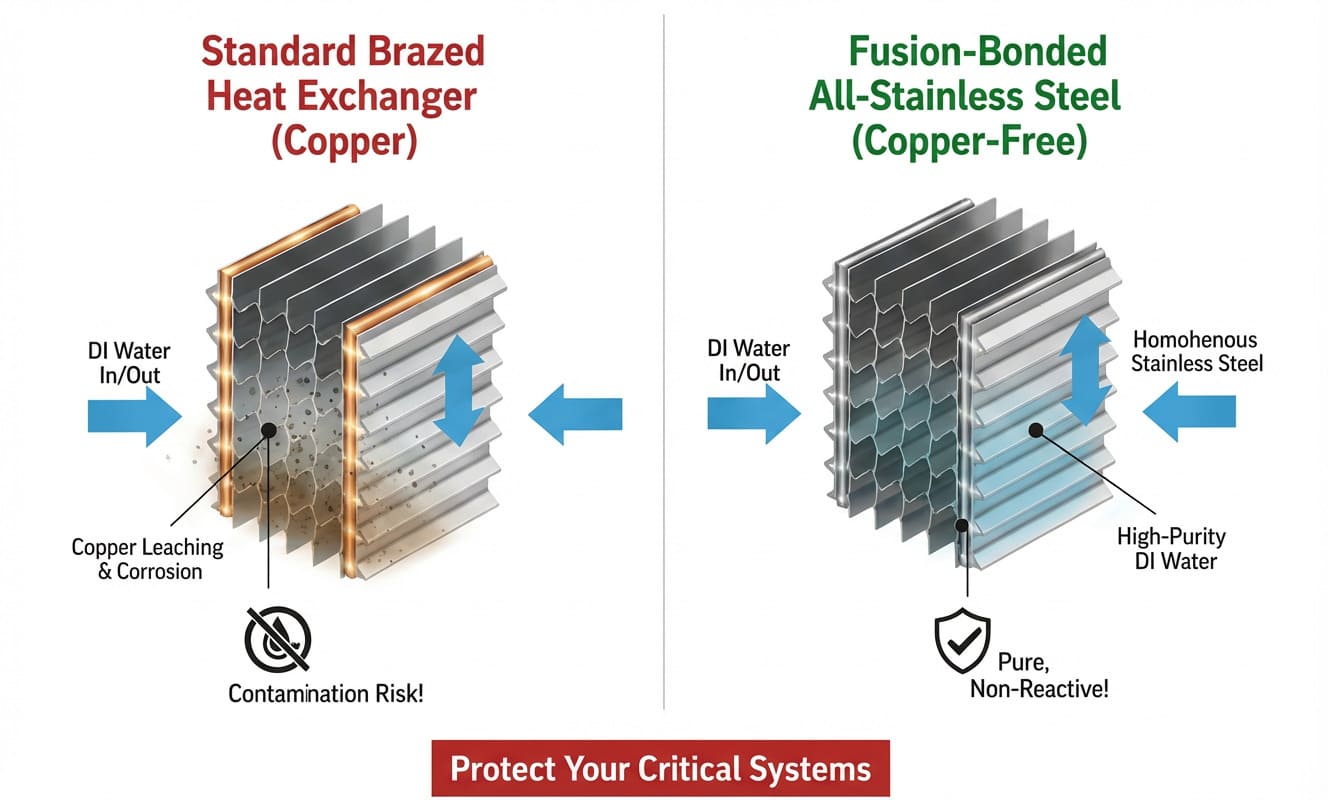
Let’s dive deeper into this. Certain applications just cannot have copper in the system. For years, engineers had to choose between a compact but risky copper-brazed unit or a very large, expensive alternative. Our fusion-bonded technology solves this problem directly. It provides a third, much better option.
The Problem with Copper in High-Purity Systems
In many advanced systems, copper is a weak link. For example, in ammonia refrigeration, ammonia gas is very aggressive towards copper. Any copper from a brazed heat exchanger will quickly corrode. This leads to leaks, system failure, and safety hazards. Similarly, data centers now use liquid cooling with Deionized (DI) water. This water is extremely pure and will pull ions from any metal it touches. Copper ions from a brazed unit will contaminate the DI water. This lowers its cooling ability and can damage sensitive electronic server components. This is also a major issue in semiconductor manufacturing, where fluid purity is everything.
TIVO's Fusion-Bonding Advantage
Our fusion-bonded heat exchangers are made from 100% stainless steel. There is no copper or nickel brazing material at all. This makes them perfect for these demanding jobs. The table below shows a clear comparison.
| Feature | Standard BPHE (Copper Brazed) | TIVO Fusion Bonded (All-Stainless Steel) |
|---|---|---|
| Material Purity | Contains Copper/Nickel filler | 100% Stainless Steel |
| Ammonia (NH₃) Compatibility | No (High Corrosion Risk) | Yes (Excellent) |
| DI Water Compatibility | No (Ion Contamination Risk) | Yes (Excellent) |
| System Lifespan | Reduced in these applications | Extended and Reliable |
| Footprint | Compact | Compact |
For engineers like Lars in Denmark, who focus on industrial ammonia refrigeration, this technology is the perfect solution. It gives him the safety and chemical compatibility he needs without the bulk of traditional welded units.
Are you overspending on titanium for low-chloride applications?
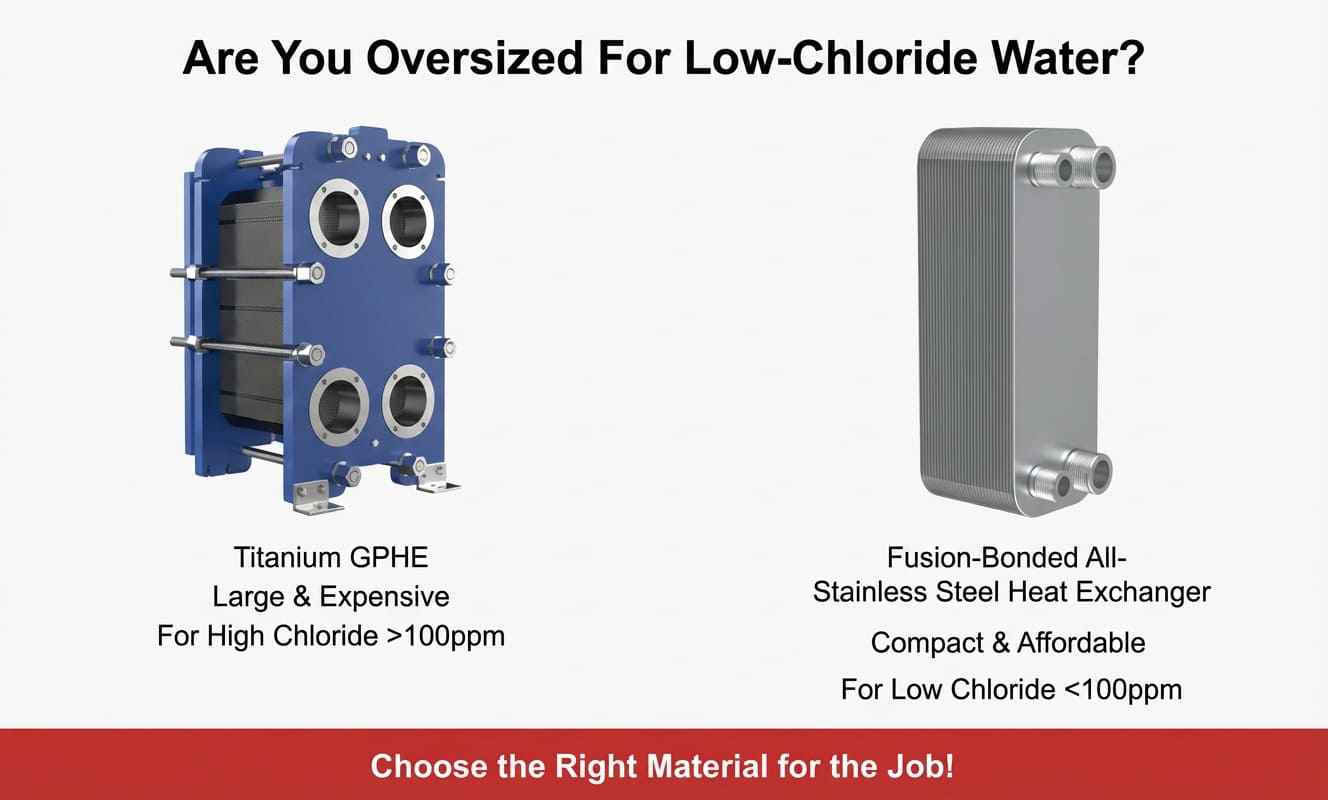
Does the mention of "chloride" in your water automatically make you choose a bulky and very expensive titanium heat exchanger4? You might be spending too much on an oversized solution.
For water with chloride levels5 under 100 parts per million (ppm), a 100% stainless steel fusion-bonded heat exchanger works perfectly. It offers great corrosion resistance in a much smaller and more affordable unit.
I see this happen all the time. An engineer sees chloride on a water report and immediately defaults to titanium. It's a safe choice, but often an unnecessary one. Understanding the real limits of stainless steel can save a project a huge amount of money and space.
The "Titanium Reflex"
Many engineers have what I call the "titanium reflex." The moment they see chloride, they specify a titanium plate heat exchanger. This is the standard solution for high-chloride environments like seawater. But it comes with big disadvantages. Titanium is an expensive material, and it is usually only available in large, gasketed plate heat exchangers. This creates two problems. First, the initial cost is very high. Second, the unit takes up a lot of valuable space. I recently spoke with a project manager, let's call him Sergey, who was planning a huge titanium unit for a cooling project. We looked at his water report together. The chloride level was only 75 ppm. He was shocked to learn there was a much better way.
The 100 ppm Stainless Steel Rule
Here is the key insight: stainless steel can handle chlorides, up to a certain point. High-quality 316L stainless steel6, which we use, can safely handle water with up to 100 ppm of chlorides without pitting or corrosion. Our fusion-bonded technology uses this material to create a compact, robust, and cost-effective unit for these exact situations. This is a perfect fit for process water or cooling tower applications where the water is treated but still contains low levels of chloride.
| Parameter | Titanium Gasketed PHE | TIVO Fusion Bonded Stainless Steel PHE |
|---|---|---|
| Chloride Limit | Very High (>1000 ppm) | < 100 ppm |
| Initial Cost | Very High | Moderate |
| Footprint / Size | Very Large | Compact |
| Maintenance | Gasket replacement required | Maintenance-free (fully welded) |
| Best Use Case | High-chloride seawater | Process water, cooling towers with <100 ppm Cl⁻ |
This knowledge helps customers like Sergey avoid huge costs on large EPC projects and helps maintenance heads like Ahmad find a reliable, affordable replacement part.
How does fusion-bonding create such a compact and robust unit?
Do you need the strength of a welded heat exchanger but the small size and efficiency of a brazed one? Our exclusive fusion-bonding process7 delivers exactly that.
Fusion-bonding is a special process where stainless steel plates are fused together on a molecular level. It uses no filler material, creating a solid, 100% stainless steel unit that's strong and leak-proof.
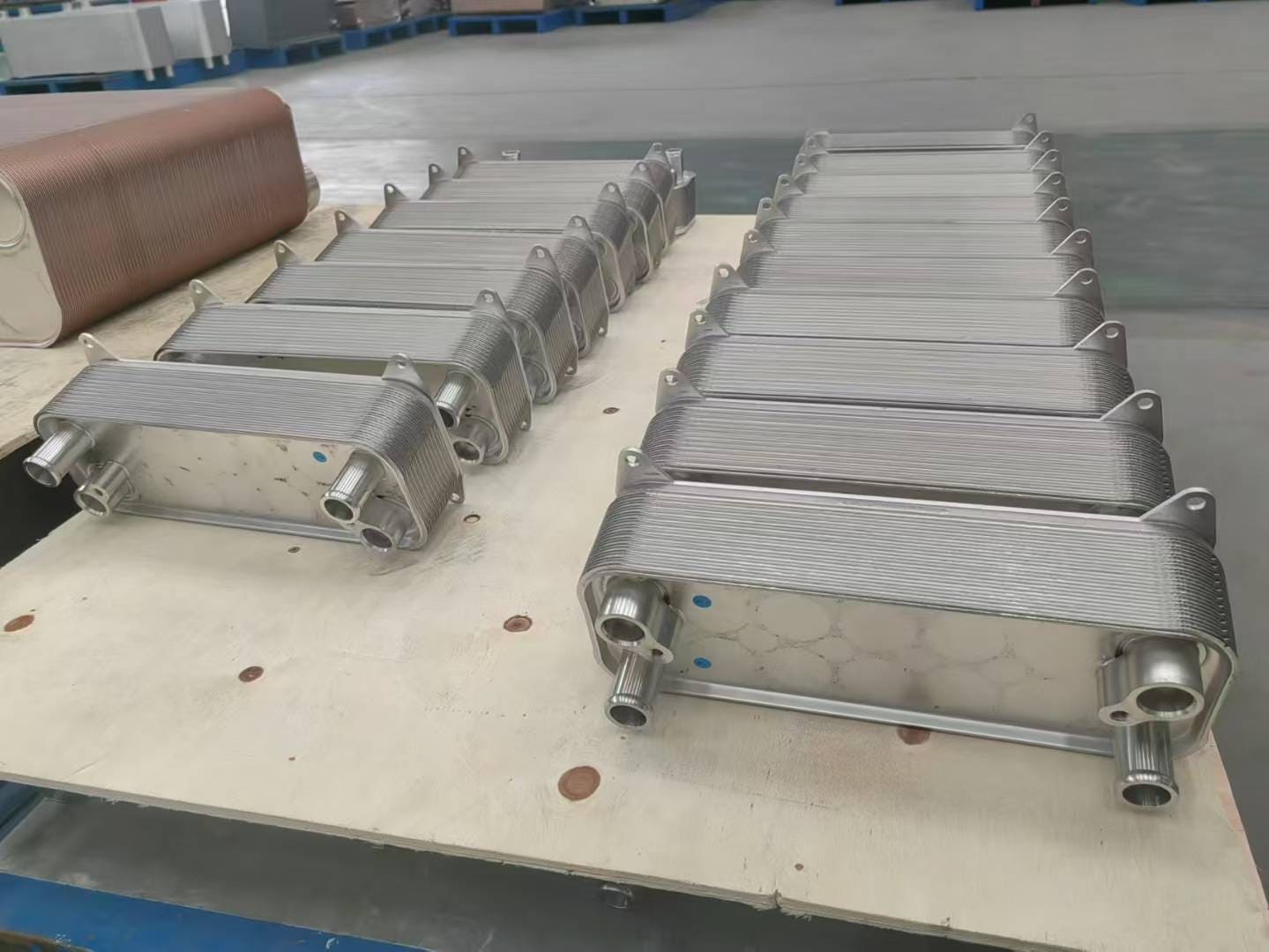
This technology is not common. We are one of only a handful of companies in the world that have mastered this process. Each of us has our own unique methods, but the goal is the same: to create a superior heat exchanger that solves problems traditional designs cannot.
A Look Inside Our Process
So, how do we do it? First, we take a stack of specially designed stainless steel plates. These plates are then placed inside a special vacuum furnace. Inside the furnace, we apply extremely high heat and pressure. This process causes the steel itself to fuse together at every contact point. It is not like brazing, where you add a different metal to act like glue. Instead, the plates become one solid piece of stainless steel. This creates an incredibly strong, monolithic block with an intricate network of channels inside for the fluids to flow through. The entire unit is strong, not just the edges.
The Result: Unmatched Performance-to-Size Ratio
The final product is amazing. It has the high-pressure resistance of a heavy-duty welded unit but keeps the high thermal efficiency and small size of a compact brazed unit. It’s the best of both worlds. For OEM manufacturers8 like David, this means he can integrate a very reliable and powerful heat exchanger into his chiller or heat pump designs without needing a lot of space. For engineers like Elena, who work with high-pressure natural refrigerants, the strength and integrity are critical. We prove this strength with tough testing, including advanced helium leak detection and burst pressure tests that ensure safety far beyond normal operating conditions. This technology gives you performance and peace of mind in one compact package.
Conclusion
Fusion-bonded heat exchangers offer a unique mix of purity, strength, and value. They are the smart choice for challenging applications where standard copper-brazed or oversized titanium units fall short.
Learn about the problems associated with copper-brazed units and why alternatives are necessary. ↩
Discover the specific challenges faced in ammonia refrigeration and how to address them effectively. ↩
Understand the risks of contamination in high-purity DI water systems and how to prevent them. ↩
Understand the drawbacks of titanium heat exchangers and when they may not be necessary. ↩
Learn about the impact of chloride levels on water systems and how to manage them. ↩
Discover the unique properties of 316L stainless steel that make it ideal for heat exchangers. ↩
Learn about the innovative fusion-bonding process and its benefits for heat exchanger design. ↩
Explore how OEM manufacturers can leverage advanced heat exchangers for better product integration. ↩